Posts Tagged NEMLA 2018
Director’s Corner (NeMLA Blog Post #22)
Posted by johnacaseyjr in Higher Ed, NEMLA, Updates on October 30, 2017
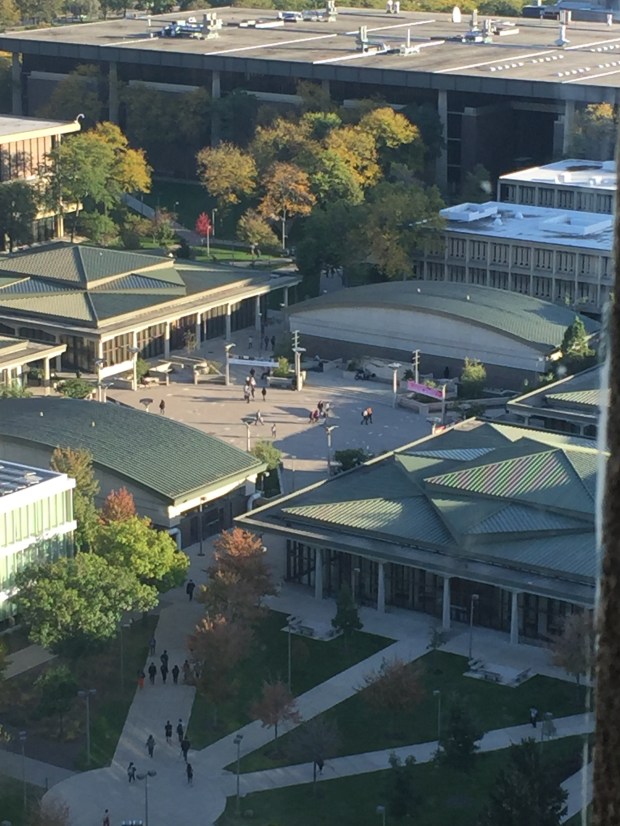
UIC East Campus Quad (photo by John Casey)
Greetings from Chicago!
After an extended period of warm weather, fall has made its appearance in the upper midwest. It’s now the tenth week of the fall semester on campus and this semester has been an incredibly busy one for me.
As usual in the fall, I’m teaching four courses instead of my usual three to meet the greater than anticipated demand of undergraduate enrollments. All four are Composition I courses and focus on analyzing genres of writing and formulating arguments. My students are finishing up a group project on a Code of Conduct for students on campus and are now beginning an Opinion Piece on immigration law.
In addition to my undergraduate teaching, I also spent seven weeks working as Interim Program Coordinator for Graduate Studies in English, helping graduate students prepare for preliminary exams and the job market.
These commitments on campus have kept me from doing much else (including writing a blog post). Today is the first time in some time that I’ve been able to turn my thoughts to issues not related to student reading, writing, and advising.
What I’d like to talk about this month is the term “Independent Scholar” and how it reflects the need for a change in how scholars and scholarship are understood in the US academic context.
I owe this topic to Megan Kate Nelson, a historian of the post-Civil War Era United States, who gave up a tenure track job to speak and write outside of a university context. She wrote a blog post in September of this year titled “Hey Academics, Please Stop Calling Me an ‘Independent Scholar” that got me thinking about how and why institutional affiliations matter in the creation and distribution of knowledge and what the future of that system might be as the ranks of academic labor continue to be filled by part-time and teaching intensive positions.
Scholars have always written and discussed their work outside of an academic context. These have been, historically, the true public intellectuals. What seems new, however, is the obsession (at least amongst academic circles) of qualifying the status of such writers and speakers as “Independent Scholars.”
To a certain extent, this sobriquet makes sense. Universities and colleges are obsessed with branding in an era of scarce resources. What better way to brand than have faculty travel around the globe to present their research with an institutional name prominently displayed on their book jackets, name tags, and event brochures?
The moniker of Independent Scholar becomes a way of simultaneously welcoming “outsiders” into academic discussions on a topic of common interest while at the same time reminding them that they are, in fact, outsiders. Their research is not connected to a brand and (sotto voce) perhaps not as worthy of our attention as this other material vouched for by an institutional affiliation.
Most of my readers won’t be shocked to hear that academic life retains something of the men’s club environment of the 19th and early 20th century. When you’re in you’re in. When you’re out you’re out. No amount of “Gatsby-like” success will change that.
What makes this problem particularly acute right now, however, and demanding of every scholar’s attention, is the continued decline of the tenured professorate with its emphasis on research, teaching, and service and its replacement by a precariate whose primary tasks are teaching and service.
Amongst the precariate, I enjoy a privileged position. I work full time (3/3) with benefits and I’ve been at my job long enough to obtain a two year contract. However, my teaching load is predominantly First Year Writing, which makes up the majority of courses taught in my department, and comes with an expectation of departmental service. Except in the fall when I teach four courses for the extra income, my teaching load is not especially burdensome. Nor is the departmental service requirement. Right now my main tasks are to evaluate one other colleague’s teaching and serve on the Steering Committee, a position I was recently elected to.
The pressures I face are primarily income related, the need to find additional work to supplement my full time income so I can afford to live in Chicago, and course selection related. I tend to teach the same courses on repeat and it takes effort to not get burned out on them. Especially when I’m teaching a group of students who often need a lot of additional help in order to succeed.
Into this hectic schedule, I somehow manage to shoehorn my research, usually in the spring semester and also over the summer. However, that research doesn’t count towards anything with my employer. I am evaluated primarily on my teaching evaluations and observations as well as the record of my departmental service. Thus, for me at least, research is a hobby that I (sort of) can indulge thanks to my job.
I wonder how many scholars are in a similar position with research relegated to a hobby they do in spite of their work rather than as a part of their work. I also wonder how many scholars are doing their work mostly as a way to keep and advance their employment position. I can count on both hands the number of disappointing monographs I’ve read by authors who clearly needed the book for a tenure file or to move up in status from visiting to permanent faculty.
The pressure that the changing professorate is placing on research will someday (probably soon) make us all “Independent Scholars.” As a result, I think it’s time for us to consider Dr. Nelson’s request that we drop institutional affiliation from our conference badges and programs and refocus our attention on the point of scholarship in the first place–the ideas.
One of the things I enjoy about attending conferences such as NeMLA is the ability to be judged on the merit of my research and writing rather than my pedigree. At my home institution, I tend to be invisible amongst the research crowd because I’m part of the “teaching pool” assigned to manage courses no one else wants to teach but that must be taught. Not so at NeMLA. I (at least) don’t care what your employment status is. I want to geek out with you for a while on the ideas you care most passionately about.
Taking away one more barrier to participation is the least that academic events can do at a time when financial pressures make it difficult if not impossible for people to attend these gatherings.
Until Next Time…
John Casey
Director’s Corner (NeMLA Blog Post #20)
Posted by johnacaseyjr in NEMLA, Updates on July 31, 2017
Greetings From Chicago!
It’s hard to believe that August starts tomorrow. Summer is moving along fast. My summer has been both restful and productive this year. Reading for my book progresses nicely and I even managed to finish revisions on my First Year Writing course early. Now I can enjoy the weeks leading up to the Fall semester without stressing over the changes needed to my course schedule and writing assignments. This year I’m teaching four sections of Academic Writing I in the Fall and I decided to focus more consciously on the concept of genre. I’ve always felt that genre represents something of an unspoken contract between the reader and the writer. It generally gives you a sense of what you are about to read and (as a writer) it gives you some parameters to work within to make sure that what you are writing is properly understood. Beyond that, I’ll be using the class to focus on implicit versus explicit argumentation. The plan is sketched out. Now I just need to make sure it actually works for the students. I should have a greater sense of this by about week 4. Stay tuned.
Tomorrow I head off for my last trip of the summer. I’m flying north to Vermont to visit my family. It’s interesting to read about my home state in the books associated with my research. The Green Mountain State keeps coming up in discussions on the various attempts throughout US history to reform agriculture and improve human relations to the land. Apparently Vermont is not only imagined as some sort of vacationer’s paradise but also as an Agrarian Utopia. Having living in Vermont for nearly 21 years of my life, I can’t help but laugh. This isn’t really the Vermont I know. Author’s on the topic of agriculture and environmentalism seem obsessed with the eclogue. I lived the georgic. I was part of the labor mechanism that supported the outsider’s illusion. Oh well, it’s good for local business and there are worse ways to make a living. Like painting old dumpsters. (Yes, this is a job I have done. Don’t recommend it for people with weak stomachs.)
For this month’s post, I want to comment a bit on the relationship between history to literature. This topic seems especially important now that shows like The Man In the High Castle and Confederate are being produced. Generally speaking, I have no problem with counter-factual narratives. Some are quite entertaining. We shouldn’t hold fiction to the same standard as non-fiction. Engaging the imagination is the point, after all, of figurative language. Getting us to imagine a world of “what if’s.” History is a different story. It relies on narrative and imagination, just like literature, but it should be held to a more vigorous standard. History needs to show us what the world was actually like at a specific place and time (good, bad, utterly horrific). We should then be able to imagine as accurately as possible what people lived through during the time period examined. Perhaps a good way to sum up the distinction I see between history and literature is that history complicates and literature creates empathy.
Of course, there are exceptions to the little schema I’ve provided above. Many of the historians I enjoy reading create empathy with the characters in their non-fiction narratives. Ken Burns is a great example of this in a visual narrative medium. Also, there are plenty of good fiction writers who complicate our relationship to the fictional world they have created. Empathy in Gone Girl is a difficult enterprise. What worries me, however, is that the line between history and literature is starting to blur to an unhealthy degree. Even more worrisome, we don’t seem to be talking enough about this blurring. It’s like I tell my writing students, you have to know the rules of writing before you can break them. Otherwise it’s just a grammatical error and not a cutting edge technique. The same is true when mixing elements of history and fiction. You have to know (or want to know) the truth before you can start engaging in the act of imagination. Otherwise you end up with narratives that consciously or sub-consciously serve dangerous ends. You start to forget what is the fictional story and what was the real course of events. You also might start to not even care anymore about the distinction.
Others have written more eloquently than me on the problems of our “post-truth” era and its relationship to “fake news” and “reality TV.” So I’ll spare you my analysis of those trends. What I want to end this discussion with instead is a provocative juxtaposition of Mad Men with The Walking Dead. Neither of these, of course, are history. They are both Television shows. What they share, however, is a similar emotional starting point. Nostalgia. In Mad Men, this nostalgia is painfully obvious in the mid-century modern details of each frame. (Material nostalgia is rampant right now and deserves a good book.) Yet it is also ambiguous in its message. Are we supposed to mourn the loss of a world where straight white men ruled the world? Where smoking and drinking happened everywhere with impunity? Or are we supposed to look back at this episode of US history as a warning and take a moment to reflect on how far we have come and how far we have yet to go? With The Walking Dead, more subtle messages (at least for me) are hidden behind the gore. If you can set aside for a moment the fact that the living dead are killing and eating people, you start to see that the show both feels nostalgic (for a world before the crisis) and also points to that nostalgia as a source of crisis.
Will we choose the Zombie or the ash tray? And are they not the same thing? A reminder that obsession with the past can be unhealthy. That what is past is never truly past. Perhaps HBO can redeem itself by staging one of Faulkner’s works like Go Down, Moses instead of a stupid fictional docudrama imagining a world where the southern states won the Civil War. Or we can take a break from imagining the past or the future and look at our present. Beautiful, Scary, Confused, Ugly, and Poignant. I’d like to see that on the page and screen.
Here is where I end my post. I just have one more thing to add. A reminder that the deadline for NeMLA paper submissions is fast approaching (September 30). You can check out the various CFP’s here <https://www.cfplist.com/nemla/Home/cfp>. I have several sessions that I have proposed. You can see descriptions of them in my last NeMLA post (#19) along with links to the CFP for those sessions. Let me know if you have any questions about what I’m looking for. If you can possible afford to attend and see a session of interest, I would very much like to meet you in Pittsburg.
Until Next Time….
John Casey
Director’s Corner (NEMLA Blog Post #18)
Posted by johnacaseyjr in Higher Ed, NEMLA, Updates on March 27, 2017
Greetings From Chicago!
After an amazing NEMLA 2017 conference in Baltimore, MD, I am back in cold, damp, and drizzly Chicago getting ready for the school week ahead. Special thanks to NEMLA Executive Director Carine Mardorossian and her staff for ensuring that everything ran smoothly. I think I can say without exaggeration that this is the best convention of the organization I have attended.
My live tweeting skills are non-existent, but I did manage to tweet after the fact some highlights from the sessions I attended. In my blog post for this month, I intend to do something similar, giving a recap of my convention experience and the conversations I was privileged to have with scholars during sessions but also out in the hallways and at the networking tables set up in the exhibit hall.
Thursday was spent on board related issues and a bit of sight seeing in the afternoon. Former NEMLA President Ben Railton and I enjoyed the exhibits at the Reginald F. Lewis Museum of Maryland African American History and Culture. I can’t speak for Ben (if you’re reading this feel free to make a comment) but I enjoyed the “living history” aspect of the museum as it tried to demonstrate the ways in which the past shaped the present culture of Maryland’s African-American population in positive and not just negative ways. Walking through these exhibits was like being invited to a sift through a family’s private collection of heirlooms. Many thanks to the staff at the museum for being so welcoming. I really enjoyed the artifacts related to Frederick Douglass’s life and time in Baltimore.
After the museum, I went to see the Baltimore maritime museum. I especially enjoyed my visit the USS Constellation, which dovetailed nicely with the Lewis museum’s exhibit on ship caulking (Douglass’s job in the Baltimore shipyards). The staff on the ship were highly knowledgeable in matters of 19th century nautical history and explained to me how a ship like the USS Constellation was built and maintained. Walking through the sailor’s quarters in the berthing deck gave me a greater appreciation for Melville’s fiction, especially his great but hardly ever read novel White Jacket. Being a sailor was (and in many ways still is) a hard life.
On Friday I began my day with a panel on poetry and had the pleasure of meeting Ron Ben-Tovim from the University of Haifa. Our paths crossed several times on Friday and Saturday as we went to many of the same sessions. He raised some very interesting questions about War Literature and the ways in which we as readers should respond to veteran’s writing. In particular, he brought up the issue of whether veterans got what they were looking for by enlisting. This, of course, raises the prior issue of what exactly they were looking for and whether their quest was directed into the appropriate channel. He also brought up the valid point that some people enjoy killing others and find liberation in the suspension of norms that is allowed by war. In addition, he reiterated a point made by Paul Fussell in his discussion of his own service in WWII that war can be both terrifying and exhilirating at the same time. It’s more complicated that being simply good or bad.
Many of these issues came up in conversation with attendees of the roundtable session I chaired and presented at on the issue of Teaching War Literature Since 9/11. Special thanks to Brittany Hirth and Lea Williams for joining me on that panel. For those who were unable to attend, my slides are available in the Writing Sample section of this website.
I also attended a session on Friday about Death and Dying (kind of a morbid subject I know) but gained a useful insight from Courtney Adams of Texas A&M University on Fight Club, a book and author that I have always had trouble connecting with. The self-destructive hero trope she analyzed says a lot about the status of masculinity in the contemporary culture of the United States today and the need to reimagine what it means to be a man.
I also had the opportunity on Friday to chair a panel Agriculture as a theme in US fiction. There were four amazing papers on very divergent topics and authors. I was left at the end of this session with a curious thought about the connection between Deep Ecology and Nativism. If you are “transplanted” to a different soil (metaphor for the immigrant’s experience) and fail to thrive, whose fault is it? That of the soil or is it your own?
I finished off my day by attending the Keynote Address by Ilan Stavans on the problem of Monolingualism. Two issues he brought up stayed with me for several days. So much so that I was speaking with strangers about it on the plane ride home. The first is the perfectionism that many of us bring to our attempts to study language. This often stops people (myself included) from learning one language let alone many because I want to be fluent instead of functional. It is a way to ensure that we stay monolingual. The second was his observation that being multilingual isn’t simply about knowing how to speak and write in another language. It is about being able to interact with another culture, often radically different from your own, but still relatable to your experience. I though of this when I took a cab ride to the airport and had an amazing conversation with the driver, a recent immigrant from Ethiopia who wants the same things for his family that I want for mine. Thank you Ilan Stavans for staying with me all the way from BWI to MDW and shaping my conversations with strangers. And bravo for being able to speak to us for so long without notes or slides. Something I aspire to.
Saturday I began my day with a panel on F.O. Matthiessen. Who knew that people still read and/or talked about him? I remembered his text American Renaissance from my undergraduate days, but just assumed that in our Critical Theory heavy environment that Matthiessen’s work would be passe. What I took away from this talk was a greater appreciation for the New Critics and what they were trying to achieve. In the contemporary narrative, Cleanth Brooks and his colleagues in the New Critical approach to teaching literature are often viewed as Ivy-league elitists when the reality is that Brooks taught at LSU Baton Rouge, hardly a bastion of elitism, and was trying to democratize the reading of fiction, making it easier for non-specialist readers to encounter. Whether they achieved their intent or not and if they had the best approach to that goal are both open to dispute. But democratizing literature still seems a worthy goal. I also found myself wondering as I left that session when did we as literary scholars come to hate or distrust the thing we teach? And if we don’t love the literature we teach, why should our students?
The capstone of my day on Saturday was the Area Special Event which my fellow Director Lisa Perdigao made possible. Brian Norman came to speak to members of the American/Anglophone and Cultural Studies/Media Studies Areas on his new project examining “posthumous autobiographies.” These are works that purport to narrate the authentic life of key figures in the Civil Rights Era that are written/edited by another author after their death. Malcolm X’s autobiography was one of the key examples given. There is some question over how much control Alex Haley had over the text and if he was simply an editor or perhaps an author of the text, subtly shaping the way we see Malcolm X and his legacy. These questions are especially poignant as the Civil Rights movement gradually moves out of living memory with participants gradually passing away. Soon all we will have to know these figures and their historical moment are the texts and monuments left behind.
Fittingly, my conference experience ended with a panel on African-American literary traditions in Baltimore, chaired by Lena Ampadu, a scholar whose essay on Paul Dunbar’s poetry was crucial in the fifth chapter of my book. I was surprised to learn in this session as well as in the one on Saturday on Literary Maryland how crucial a role William Watkins played in the life of so many African-American authors and yet how little we know about him. The world of African-American activist fiction was much more interconnected than I thought it was. There is a clear intellectual history that develops from these personal connections that really needs a book to outline if. If that book already exists, let me know. It is an area that I only have limited knowledge in, mostly related to Frederick Douglass and Francis E.W. Harper.
After that session, I had the pleasure of reconnecting with an old friend from UIC grad school days and meeting her husband and son (NEMLA is a family friendly conference). Then it was off to BWI and back to Chicago to prepare for next year’s conference in Pittsburg.
If you have a session that you would like to propose for NEMLA 2018, you can find a link to propose that session here: https://www.buffalo.edu/nemla/convention/session.html. Sessions should be on a topic that you feel might be of interest to a wide range of scholars. Try not to be too specific in your abstract or too broad. A few topics that I would like to see represented in Pittsburg include: Women at Work, Class Issues in US fiction, Representations of Disability, Immigrant Narratives in US fiction, Bilingual Authors and Texts in US literature, and Native American Fiction in the US. Other topics, of course, are welcome. If you’re not sure how or if your abstract will work, email me directly and we can discuss it. The deadline for session proposals is APRIL 29. Once the sessions have been vetted, a CFP will go out for papers and presentations. Usually this happens in mid to late May.
Thank you to all who attended NEMLA. Our members are what make this organization great. Please join us Pittsburg. Our new president Maria DiFrancesco has an amazing conference planned.
Until Next Time….
John Casey
 John A Casey Jr