Posts Tagged Director’s Corner
Director’s Corner (NeMLA Blog Post #23)
Posted by johnacaseyjr in Chicago Literature, NEMLA, Updates on March 2, 2018
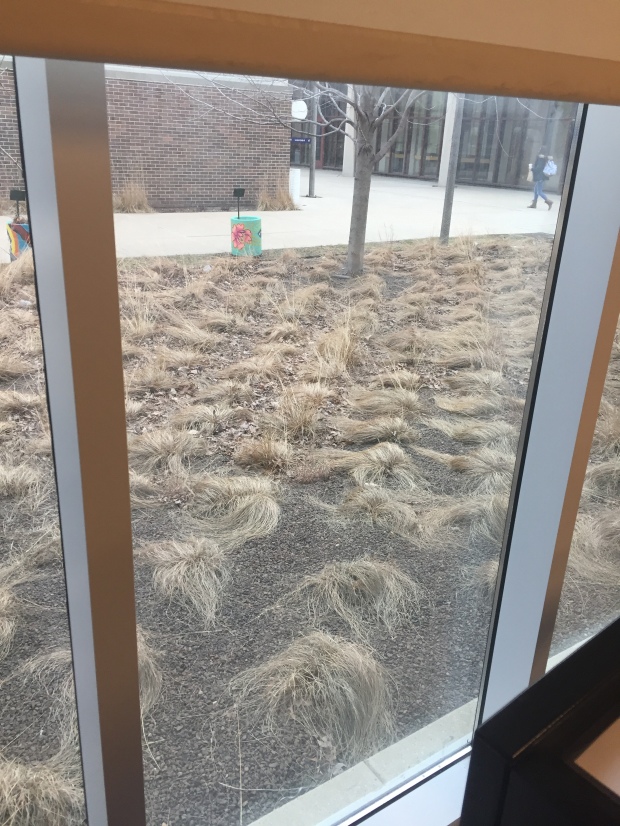
View Outside My Classroom Window. February 22, 2018. Photo by John Casey.
Greetings from Chicago!
Looking at my list of Blog Posts, I see that it has been since October that I’ve last written anything for this column. I guess the easiest way to explain that (aside from Holiday planning and travel) is that I didn’t have much to write about in those intervening months.
Today I decided to open my computer and write what will be my second to last post as Director of Anglophone/American Literature at NeMLA. My position ends at this year’s conference in Pittsburgh.
Before I launch into the topic for this post (the role of the imagination in literary studies), I just want to take a moment to thank a few people who have made my experience as Director incredibly rewarding. First, there’s Ben Railton, who put into my head the idea that I could self-nominate for this position and actually get elected. Then there are my fellow Director’s Susmita Roye and Lisa Perdigao both of whom I have had the privilege of collaborating with on Special Events programing. I learned a lot from their past experience. Thanks to Carine Mardorossian for being so patient with me as a newbie to NeMLA and to Brandi So who helped me with more than a few software glitch issues. Finally, I’d like to thank the members of NeMLA, without whom there wouldn’t be a need for a board at all. It’s been a privilege to serve you in the role of Director and a real treat to get to view the session proposals for the entire conference. Let no one tell you that literary studies isn’t strong as a field. It’s simply evolving (perhaps a bit slowly) to meet the times.
I hope to meet some of my readers in Pittsburg and hear the wonderful research projects you are working on. Remember to look for my signature bow tie. : )
Several semesters ago, I taught a version of a course on Literary Criticism and Literary Theory that began with a pair of essays. One was by Susan Sontag and the other by Jean Paul Sartre. In the first of these essays, Sontag decried the violence of literary analysis as it is taught in schools, ripping apart a work of art to see how it works rather than appreciating it for what it is–a mode of expression where the parts are greater than the whole and meaning can never fully be discerned. She made the daring claim that we should simply learn to emotionally engage with art as art rather than forcing it to mean something. Sartre, in contrast, argued that art and artists had an obligation to engage their audience to effect change in the world. (It’s not accidental that Sartre is probably better known and understood for his fiction than his philosophical treatises.)
These essays were meant to provoke a semester long conversation on what exactly this thing we call “literature” is and what as dedicated readers we are supposed to do with it. Not surprisingly, we came to no consensus on these issues. Here are how my thoughts have evolved on the subject since I first chose to introduce it in this class.
On the one hand, I find myself agreeing with Sontag. Poems, Short Stories, Novels, all the ways that humans can be creative are not like machines that can be ripped apart and studied for how and why they work. Perhaps the best critique of this reductionist approach to literature comes from Edgar Allan Poe when he explains his poem “The Raven.”
Yet, on the other hand, I can’t help but feel drawn to Sartre’s perspective that no form of communication is disinterested. Even artists want something from us.
How do I reconcile these twin beliefs? I focus on characters in fiction who become more real to us than the people we see on the streets every day.
This semester I am teaching an Introduction to American Literature course. I’ve always been committed to teaching works by lesser known and local authors. This spring I chose to meet that goal by teaching a course on Chicago Literature.
So far we have read poems by Carl Sandburg and Gwendolyn Brooks. Works by contemporary poets Eve Ewing and Kevin Coval are yet to come. We’ve also read novels by Theodore Dreiser (Sister Carrie) and Richard Wright (Native Son) and still have works by Nelson Algren and Bill Hillmann waiting for us towards the semester’s end.
Since our classroom looks out on the loop and the Sears Tower, it’s not hard for us to envision the world these writer’s create.
Teaching the Sandburg poem “Halsted Street Car,” I told my students to think of their morning commute. How many of us have seen the exhausted workers whose faces are “tired of wishes / empty of dreams.”
Reading Sister Carrie, I asked them to imagine her walking through the State Street shopping corridor, arm in arm with her dapper salesman boyfriend Charles Drouet. Who, I asked, are the Carrie’s they see walking that same street today? Where are the Drouet’s? The materialist desires both represent are far from gone. Otherwise, why would the stores still be there?
With Native Son, we reflected this week on the legacy of the Kerner Report and the growing number of black males in prison. I asked my students to find cases similar to that of Bigger Thomas and they delivered. I asked them to imagine what Bigger’s life would be like without racial barriers and we couldn’t. Even in our imagination he remained a criminal, just maybe not a double murderer.
Now as we move on to Gwendolyn Brooks, we are considering the role of black women in the worn out communities of the South and West Sides who are asked to hold the tattered fabric of community together against tremendous odds.
I see Sister Carrie and Charles Drouet, Bigger Thomas and his mother, Sandburg’s Contemporary Bunkshooter, and Gwendolyn Brooks’ Sadie and Maude and Chocolate Mabbie. I see them all when I walk the streets of my Chicago.
And what do these fictional characters become real mean to me?
First, they remind me to be careful. That it is easy for the imagination to wander into the realm of stereotype and through that engage in prejudiced actions.
Second, they remind me that although Chicago is a city that isn’t kind to fools and where a wrong turn can lead to a quick end, it is also a city of resilience and incredible kindness (especially among those who have nothing). Some of the kindest and most decent people I have meet are from areas in the South Side that outsiders are warned to stay way from.
And third, they remind me that the imagination is about envisioning what isn’t there or what might be and not simply a way to see “what is” in a different light. One persons’ realism, after all, is another person’s utopia.
As a teacher, I never know what my student’s will take away from my classes. Teaching literature itself can be as unpredictable as the art we examine. I do hope, however, that my students will think about the thorny issue of how “art follows life” and use that as a spur for action. To create the neighborhoods they want to live in rather than driving over the same damn potholes their grandparents cursed at.
Until Next Time….
John Casey
Director’s Corner (NeMLA Blog Post #22)
Posted by johnacaseyjr in Higher Ed, NEMLA, Updates on October 30, 2017
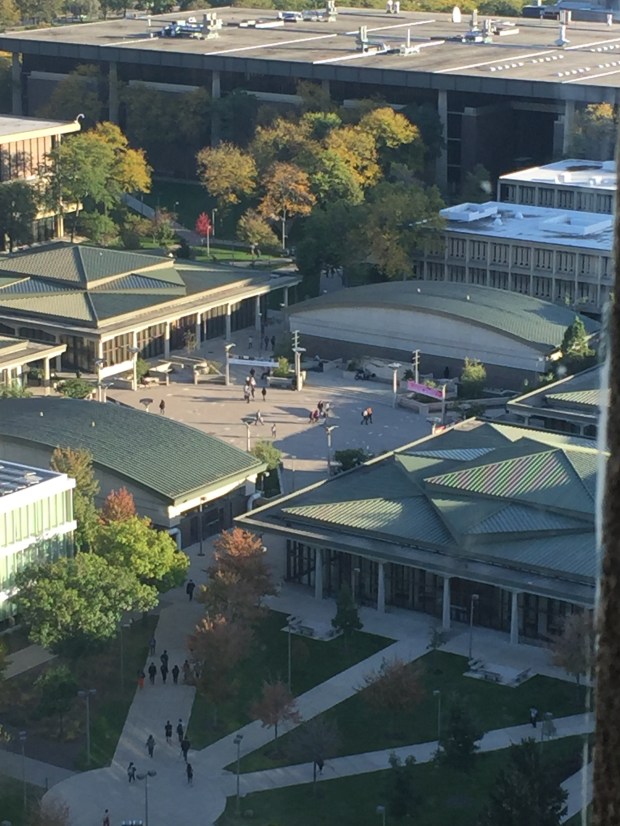
UIC East Campus Quad (photo by John Casey)
Greetings from Chicago!
After an extended period of warm weather, fall has made its appearance in the upper midwest. It’s now the tenth week of the fall semester on campus and this semester has been an incredibly busy one for me.
As usual in the fall, I’m teaching four courses instead of my usual three to meet the greater than anticipated demand of undergraduate enrollments. All four are Composition I courses and focus on analyzing genres of writing and formulating arguments. My students are finishing up a group project on a Code of Conduct for students on campus and are now beginning an Opinion Piece on immigration law.
In addition to my undergraduate teaching, I also spent seven weeks working as Interim Program Coordinator for Graduate Studies in English, helping graduate students prepare for preliminary exams and the job market.
These commitments on campus have kept me from doing much else (including writing a blog post). Today is the first time in some time that I’ve been able to turn my thoughts to issues not related to student reading, writing, and advising.
What I’d like to talk about this month is the term “Independent Scholar” and how it reflects the need for a change in how scholars and scholarship are understood in the US academic context.
I owe this topic to Megan Kate Nelson, a historian of the post-Civil War Era United States, who gave up a tenure track job to speak and write outside of a university context. She wrote a blog post in September of this year titled “Hey Academics, Please Stop Calling Me an ‘Independent Scholar” that got me thinking about how and why institutional affiliations matter in the creation and distribution of knowledge and what the future of that system might be as the ranks of academic labor continue to be filled by part-time and teaching intensive positions.
Scholars have always written and discussed their work outside of an academic context. These have been, historically, the true public intellectuals. What seems new, however, is the obsession (at least amongst academic circles) of qualifying the status of such writers and speakers as “Independent Scholars.”
To a certain extent, this sobriquet makes sense. Universities and colleges are obsessed with branding in an era of scarce resources. What better way to brand than have faculty travel around the globe to present their research with an institutional name prominently displayed on their book jackets, name tags, and event brochures?
The moniker of Independent Scholar becomes a way of simultaneously welcoming “outsiders” into academic discussions on a topic of common interest while at the same time reminding them that they are, in fact, outsiders. Their research is not connected to a brand and (sotto voce) perhaps not as worthy of our attention as this other material vouched for by an institutional affiliation.
Most of my readers won’t be shocked to hear that academic life retains something of the men’s club environment of the 19th and early 20th century. When you’re in you’re in. When you’re out you’re out. No amount of “Gatsby-like” success will change that.
What makes this problem particularly acute right now, however, and demanding of every scholar’s attention, is the continued decline of the tenured professorate with its emphasis on research, teaching, and service and its replacement by a precariate whose primary tasks are teaching and service.
Amongst the precariate, I enjoy a privileged position. I work full time (3/3) with benefits and I’ve been at my job long enough to obtain a two year contract. However, my teaching load is predominantly First Year Writing, which makes up the majority of courses taught in my department, and comes with an expectation of departmental service. Except in the fall when I teach four courses for the extra income, my teaching load is not especially burdensome. Nor is the departmental service requirement. Right now my main tasks are to evaluate one other colleague’s teaching and serve on the Steering Committee, a position I was recently elected to.
The pressures I face are primarily income related, the need to find additional work to supplement my full time income so I can afford to live in Chicago, and course selection related. I tend to teach the same courses on repeat and it takes effort to not get burned out on them. Especially when I’m teaching a group of students who often need a lot of additional help in order to succeed.
Into this hectic schedule, I somehow manage to shoehorn my research, usually in the spring semester and also over the summer. However, that research doesn’t count towards anything with my employer. I am evaluated primarily on my teaching evaluations and observations as well as the record of my departmental service. Thus, for me at least, research is a hobby that I (sort of) can indulge thanks to my job.
I wonder how many scholars are in a similar position with research relegated to a hobby they do in spite of their work rather than as a part of their work. I also wonder how many scholars are doing their work mostly as a way to keep and advance their employment position. I can count on both hands the number of disappointing monographs I’ve read by authors who clearly needed the book for a tenure file or to move up in status from visiting to permanent faculty.
The pressure that the changing professorate is placing on research will someday (probably soon) make us all “Independent Scholars.” As a result, I think it’s time for us to consider Dr. Nelson’s request that we drop institutional affiliation from our conference badges and programs and refocus our attention on the point of scholarship in the first place–the ideas.
One of the things I enjoy about attending conferences such as NeMLA is the ability to be judged on the merit of my research and writing rather than my pedigree. At my home institution, I tend to be invisible amongst the research crowd because I’m part of the “teaching pool” assigned to manage courses no one else wants to teach but that must be taught. Not so at NeMLA. I (at least) don’t care what your employment status is. I want to geek out with you for a while on the ideas you care most passionately about.
Taking away one more barrier to participation is the least that academic events can do at a time when financial pressures make it difficult if not impossible for people to attend these gatherings.
Until Next Time…
John Casey
Director’s Corner (NeMLA Blog Post #21)
Posted by johnacaseyjr in Higher Ed, NEMLA, Updates on August 28, 2017
Greetings from Chicago!
The start of the fall semester is fast approaching and while I will miss the more relaxed schedule of my summer days, I am looking forward to meeting the incoming class of first year students at UIC. I often forget how unique my experience is on campus as I look out at a group of students who are truly diverse in terms of ethnicity, race, gender, and religion. These students teach me about what “America” is actually like and what it can be in the years to come even as I help teach them the literacy skills they will need to succeed.
Fall is always the busiest semester for me and this fall is no exception. I’ll be teaching four sections of Academic Writing I, the first class in the First Year Writing sequence, with a total of 96 students. This year I’ve decided to focus that class primarily on genre so that we can consider how the forms we choose to write in signal to our readers what we intend and shape the ways we use language. I also plan to consider how our language choices as writers can shift the ways in which readers understand a genre. Stay tuned as the semester progresses to hear more on how my writing classes are going.
In this month’s blog post, I’d like to consider the role of classroom design in the way that faculty teach. For those of us who read Inside Higher Education or The Chronicle of Higher Education, articles on the death of the lecture and the need for more active forms of student learning are commonplace. There has also been a resurgence lately in these publications of articles on the pros and cons of using technology in the classroom. What gets missed in most of these articles, however, is any real discussion of the actual classroom. How is it designed?
As with most form’s of infrastructure, the physical reality of the classroom is taken for granted. A board, some desks, a few square feet of floor space sufficient to cover max enrollment. Maybe a TV or projector system. But if colleges and universities want to change the way they teach, there needs to be greater emphasis on the spatial design of the classroom.
Traditional lecture halls were designed with a sloping or step down tier system. There also tends to be a curvature to these lecture halls. Students eyes are thus directed downward towards a common focal point–a lectern, chalkboard, whiteboard, or projector screen. Aside from the access issues these rooms present for physically disabled students, who might not want to sit all the way in the back or right up in the front, this traditional design sends a clear message about who is in charge and how knowledge gets distributed. Some faculty might try to counter this trend by using the room in a unique way, but the design can’t help but frustrate that intent. Group work and peer to peer discussion will always lead back to the focal point down below.
Rooms designed for a lecture/discussion format or a lab are a little better in terms of floor design. The floor space is flat and holds a smaller number of students. Some have fixed desks while others have movable desk and chair combos. Often, however, the square footage of the room prohibits a great deal of movement of these desks. It also takes considerable time and effort for faculty and students to rearrange desks for small group activities and discussion. The path of least resistance, therefore, is to leave them pointed towards the lectern, chalkboard, whiteboard, or projector. Student vision is distributed in a straight line but is still directed towards the professor. Thus turning the classroom on most days into a smaller lecture hall with a flat floor.
Of the two existing options in classroom design, the spaces allocated for lecture/discussion classes have the greatest potential for adaptability. They often, however, have too many students in them to make movement practicable on a regular basis. One solution, certainly controversial, is to reduce the number of students placed in these classrooms or at the very least to revisit how max occupancy standards are arrived at. On my campus, the Fire Marshall is the main factor determining this rather than pedagogical research. There is definitely a need for more research on the optimal number of students that should be in a room for a certain type of teaching method to succeed. This would give student advocates and faculty interested in changing to more active learning strategies some data to make their case for much needed changes. Right now, much of the discussion on this topic remains anecdotal and (therefore) gets ignored by campus administrators.
For those campuses lucky enough to have the money to build new classroom facilities, the issue is a different one. Should new lecture halls be built to create spaces for an evolved version of a venerable teaching method? Or should all new class space follow the call for more active learning (sometimes called a flipped classroom)? I’m of the opinion that new construction should contain spaces for all types of educational method currently applied such as lecture and lecture/discussion. New experimental spaces should also be constructed that allow for project based learning–small group activities and discussions. These spaces should imagine such active learning as on-going and not simply one method of using a lecture/discussion space.
This fall one of my first year writing courses will be held in an experimental classroom. It is a traditional lecture/discussion classroom that is being fitted with new desk and chair combos as well as touch screen monitors assigned to various clusters of desks. These monitors are supposed to allow students to work in small groups on assigned activities easier as well as discuss readings. The monitors are connected by a wireless system to the podium at the front of the room, which will allow me (should I choose to do so) to project what each group is working on up on the main projector screen for the entire class to see. I’m sanguine about what I’ll be able to accomplish in this set up with that group of writing students. As I get a better sense of what is different, I’ll let you know since I’m also teaching in three more traditionally designed lecture/discussion classrooms.
What I can say before I even get started in using the space, is that I’m afraid classroom designers (and some faculty) focus too much on technology (projectors and screens) as well as desks. The real focus (in my opinion) should be on square footage, focal points, and lighting. There should also be some consideration on storage for backpacks and winter coats as well as access to electrical outlets. For the experimental classroom I’m teaching in, I believe that racks will be installed under the chairs. We’ll see how that works. The electrical outlet set up will remain the same. Temperature of the room and wall color are also important. And, just as important, the room should make disability access seamless. Too often, the design of a classroom makes it feel like disabled students are being accommodated. They should be allowed to feel like the other students attending the class.
I hope that you all enjoy the waning days of summer.
Until Next Time…
John Casey
Director’s Corner (NeMLA Blog Post #20)
Posted by johnacaseyjr in NEMLA, Updates on July 31, 2017
Greetings From Chicago!
It’s hard to believe that August starts tomorrow. Summer is moving along fast. My summer has been both restful and productive this year. Reading for my book progresses nicely and I even managed to finish revisions on my First Year Writing course early. Now I can enjoy the weeks leading up to the Fall semester without stressing over the changes needed to my course schedule and writing assignments. This year I’m teaching four sections of Academic Writing I in the Fall and I decided to focus more consciously on the concept of genre. I’ve always felt that genre represents something of an unspoken contract between the reader and the writer. It generally gives you a sense of what you are about to read and (as a writer) it gives you some parameters to work within to make sure that what you are writing is properly understood. Beyond that, I’ll be using the class to focus on implicit versus explicit argumentation. The plan is sketched out. Now I just need to make sure it actually works for the students. I should have a greater sense of this by about week 4. Stay tuned.
Tomorrow I head off for my last trip of the summer. I’m flying north to Vermont to visit my family. It’s interesting to read about my home state in the books associated with my research. The Green Mountain State keeps coming up in discussions on the various attempts throughout US history to reform agriculture and improve human relations to the land. Apparently Vermont is not only imagined as some sort of vacationer’s paradise but also as an Agrarian Utopia. Having living in Vermont for nearly 21 years of my life, I can’t help but laugh. This isn’t really the Vermont I know. Author’s on the topic of agriculture and environmentalism seem obsessed with the eclogue. I lived the georgic. I was part of the labor mechanism that supported the outsider’s illusion. Oh well, it’s good for local business and there are worse ways to make a living. Like painting old dumpsters. (Yes, this is a job I have done. Don’t recommend it for people with weak stomachs.)
For this month’s post, I want to comment a bit on the relationship between history to literature. This topic seems especially important now that shows like The Man In the High Castle and Confederate are being produced. Generally speaking, I have no problem with counter-factual narratives. Some are quite entertaining. We shouldn’t hold fiction to the same standard as non-fiction. Engaging the imagination is the point, after all, of figurative language. Getting us to imagine a world of “what if’s.” History is a different story. It relies on narrative and imagination, just like literature, but it should be held to a more vigorous standard. History needs to show us what the world was actually like at a specific place and time (good, bad, utterly horrific). We should then be able to imagine as accurately as possible what people lived through during the time period examined. Perhaps a good way to sum up the distinction I see between history and literature is that history complicates and literature creates empathy.
Of course, there are exceptions to the little schema I’ve provided above. Many of the historians I enjoy reading create empathy with the characters in their non-fiction narratives. Ken Burns is a great example of this in a visual narrative medium. Also, there are plenty of good fiction writers who complicate our relationship to the fictional world they have created. Empathy in Gone Girl is a difficult enterprise. What worries me, however, is that the line between history and literature is starting to blur to an unhealthy degree. Even more worrisome, we don’t seem to be talking enough about this blurring. It’s like I tell my writing students, you have to know the rules of writing before you can break them. Otherwise it’s just a grammatical error and not a cutting edge technique. The same is true when mixing elements of history and fiction. You have to know (or want to know) the truth before you can start engaging in the act of imagination. Otherwise you end up with narratives that consciously or sub-consciously serve dangerous ends. You start to forget what is the fictional story and what was the real course of events. You also might start to not even care anymore about the distinction.
Others have written more eloquently than me on the problems of our “post-truth” era and its relationship to “fake news” and “reality TV.” So I’ll spare you my analysis of those trends. What I want to end this discussion with instead is a provocative juxtaposition of Mad Men with The Walking Dead. Neither of these, of course, are history. They are both Television shows. What they share, however, is a similar emotional starting point. Nostalgia. In Mad Men, this nostalgia is painfully obvious in the mid-century modern details of each frame. (Material nostalgia is rampant right now and deserves a good book.) Yet it is also ambiguous in its message. Are we supposed to mourn the loss of a world where straight white men ruled the world? Where smoking and drinking happened everywhere with impunity? Or are we supposed to look back at this episode of US history as a warning and take a moment to reflect on how far we have come and how far we have yet to go? With The Walking Dead, more subtle messages (at least for me) are hidden behind the gore. If you can set aside for a moment the fact that the living dead are killing and eating people, you start to see that the show both feels nostalgic (for a world before the crisis) and also points to that nostalgia as a source of crisis.
Will we choose the Zombie or the ash tray? And are they not the same thing? A reminder that obsession with the past can be unhealthy. That what is past is never truly past. Perhaps HBO can redeem itself by staging one of Faulkner’s works like Go Down, Moses instead of a stupid fictional docudrama imagining a world where the southern states won the Civil War. Or we can take a break from imagining the past or the future and look at our present. Beautiful, Scary, Confused, Ugly, and Poignant. I’d like to see that on the page and screen.
Here is where I end my post. I just have one more thing to add. A reminder that the deadline for NeMLA paper submissions is fast approaching (September 30). You can check out the various CFP’s here <https://www.cfplist.com/nemla/Home/cfp>. I have several sessions that I have proposed. You can see descriptions of them in my last NeMLA post (#19) along with links to the CFP for those sessions. Let me know if you have any questions about what I’m looking for. If you can possible afford to attend and see a session of interest, I would very much like to meet you in Pittsburg.
Until Next Time….
John Casey
Director’s Corner (NEMLA Blog Post #18)
Posted by johnacaseyjr in Higher Ed, NEMLA, Updates on March 27, 2017
Greetings From Chicago!
After an amazing NEMLA 2017 conference in Baltimore, MD, I am back in cold, damp, and drizzly Chicago getting ready for the school week ahead. Special thanks to NEMLA Executive Director Carine Mardorossian and her staff for ensuring that everything ran smoothly. I think I can say without exaggeration that this is the best convention of the organization I have attended.
My live tweeting skills are non-existent, but I did manage to tweet after the fact some highlights from the sessions I attended. In my blog post for this month, I intend to do something similar, giving a recap of my convention experience and the conversations I was privileged to have with scholars during sessions but also out in the hallways and at the networking tables set up in the exhibit hall.
Thursday was spent on board related issues and a bit of sight seeing in the afternoon. Former NEMLA President Ben Railton and I enjoyed the exhibits at the Reginald F. Lewis Museum of Maryland African American History and Culture. I can’t speak for Ben (if you’re reading this feel free to make a comment) but I enjoyed the “living history” aspect of the museum as it tried to demonstrate the ways in which the past shaped the present culture of Maryland’s African-American population in positive and not just negative ways. Walking through these exhibits was like being invited to a sift through a family’s private collection of heirlooms. Many thanks to the staff at the museum for being so welcoming. I really enjoyed the artifacts related to Frederick Douglass’s life and time in Baltimore.
After the museum, I went to see the Baltimore maritime museum. I especially enjoyed my visit the USS Constellation, which dovetailed nicely with the Lewis museum’s exhibit on ship caulking (Douglass’s job in the Baltimore shipyards). The staff on the ship were highly knowledgeable in matters of 19th century nautical history and explained to me how a ship like the USS Constellation was built and maintained. Walking through the sailor’s quarters in the berthing deck gave me a greater appreciation for Melville’s fiction, especially his great but hardly ever read novel White Jacket. Being a sailor was (and in many ways still is) a hard life.
On Friday I began my day with a panel on poetry and had the pleasure of meeting Ron Ben-Tovim from the University of Haifa. Our paths crossed several times on Friday and Saturday as we went to many of the same sessions. He raised some very interesting questions about War Literature and the ways in which we as readers should respond to veteran’s writing. In particular, he brought up the issue of whether veterans got what they were looking for by enlisting. This, of course, raises the prior issue of what exactly they were looking for and whether their quest was directed into the appropriate channel. He also brought up the valid point that some people enjoy killing others and find liberation in the suspension of norms that is allowed by war. In addition, he reiterated a point made by Paul Fussell in his discussion of his own service in WWII that war can be both terrifying and exhilirating at the same time. It’s more complicated that being simply good or bad.
Many of these issues came up in conversation with attendees of the roundtable session I chaired and presented at on the issue of Teaching War Literature Since 9/11. Special thanks to Brittany Hirth and Lea Williams for joining me on that panel. For those who were unable to attend, my slides are available in the Writing Sample section of this website.
I also attended a session on Friday about Death and Dying (kind of a morbid subject I know) but gained a useful insight from Courtney Adams of Texas A&M University on Fight Club, a book and author that I have always had trouble connecting with. The self-destructive hero trope she analyzed says a lot about the status of masculinity in the contemporary culture of the United States today and the need to reimagine what it means to be a man.
I also had the opportunity on Friday to chair a panel Agriculture as a theme in US fiction. There were four amazing papers on very divergent topics and authors. I was left at the end of this session with a curious thought about the connection between Deep Ecology and Nativism. If you are “transplanted” to a different soil (metaphor for the immigrant’s experience) and fail to thrive, whose fault is it? That of the soil or is it your own?
I finished off my day by attending the Keynote Address by Ilan Stavans on the problem of Monolingualism. Two issues he brought up stayed with me for several days. So much so that I was speaking with strangers about it on the plane ride home. The first is the perfectionism that many of us bring to our attempts to study language. This often stops people (myself included) from learning one language let alone many because I want to be fluent instead of functional. It is a way to ensure that we stay monolingual. The second was his observation that being multilingual isn’t simply about knowing how to speak and write in another language. It is about being able to interact with another culture, often radically different from your own, but still relatable to your experience. I though of this when I took a cab ride to the airport and had an amazing conversation with the driver, a recent immigrant from Ethiopia who wants the same things for his family that I want for mine. Thank you Ilan Stavans for staying with me all the way from BWI to MDW and shaping my conversations with strangers. And bravo for being able to speak to us for so long without notes or slides. Something I aspire to.
Saturday I began my day with a panel on F.O. Matthiessen. Who knew that people still read and/or talked about him? I remembered his text American Renaissance from my undergraduate days, but just assumed that in our Critical Theory heavy environment that Matthiessen’s work would be passe. What I took away from this talk was a greater appreciation for the New Critics and what they were trying to achieve. In the contemporary narrative, Cleanth Brooks and his colleagues in the New Critical approach to teaching literature are often viewed as Ivy-league elitists when the reality is that Brooks taught at LSU Baton Rouge, hardly a bastion of elitism, and was trying to democratize the reading of fiction, making it easier for non-specialist readers to encounter. Whether they achieved their intent or not and if they had the best approach to that goal are both open to dispute. But democratizing literature still seems a worthy goal. I also found myself wondering as I left that session when did we as literary scholars come to hate or distrust the thing we teach? And if we don’t love the literature we teach, why should our students?
The capstone of my day on Saturday was the Area Special Event which my fellow Director Lisa Perdigao made possible. Brian Norman came to speak to members of the American/Anglophone and Cultural Studies/Media Studies Areas on his new project examining “posthumous autobiographies.” These are works that purport to narrate the authentic life of key figures in the Civil Rights Era that are written/edited by another author after their death. Malcolm X’s autobiography was one of the key examples given. There is some question over how much control Alex Haley had over the text and if he was simply an editor or perhaps an author of the text, subtly shaping the way we see Malcolm X and his legacy. These questions are especially poignant as the Civil Rights movement gradually moves out of living memory with participants gradually passing away. Soon all we will have to know these figures and their historical moment are the texts and monuments left behind.
Fittingly, my conference experience ended with a panel on African-American literary traditions in Baltimore, chaired by Lena Ampadu, a scholar whose essay on Paul Dunbar’s poetry was crucial in the fifth chapter of my book. I was surprised to learn in this session as well as in the one on Saturday on Literary Maryland how crucial a role William Watkins played in the life of so many African-American authors and yet how little we know about him. The world of African-American activist fiction was much more interconnected than I thought it was. There is a clear intellectual history that develops from these personal connections that really needs a book to outline if. If that book already exists, let me know. It is an area that I only have limited knowledge in, mostly related to Frederick Douglass and Francis E.W. Harper.
After that session, I had the pleasure of reconnecting with an old friend from UIC grad school days and meeting her husband and son (NEMLA is a family friendly conference). Then it was off to BWI and back to Chicago to prepare for next year’s conference in Pittsburg.
If you have a session that you would like to propose for NEMLA 2018, you can find a link to propose that session here: https://www.buffalo.edu/nemla/convention/session.html. Sessions should be on a topic that you feel might be of interest to a wide range of scholars. Try not to be too specific in your abstract or too broad. A few topics that I would like to see represented in Pittsburg include: Women at Work, Class Issues in US fiction, Representations of Disability, Immigrant Narratives in US fiction, Bilingual Authors and Texts in US literature, and Native American Fiction in the US. Other topics, of course, are welcome. If you’re not sure how or if your abstract will work, email me directly and we can discuss it. The deadline for session proposals is APRIL 29. Once the sessions have been vetted, a CFP will go out for papers and presentations. Usually this happens in mid to late May.
Thank you to all who attended NEMLA. Our members are what make this organization great. Please join us Pittsburg. Our new president Maria DiFrancesco has an amazing conference planned.
Until Next Time….
John Casey
Director’s Corner (NEMLA Blog Post #17)
Posted by johnacaseyjr in Higher Ed, NEMLA, Updates on March 14, 2017
Greetings from Chicago!
Today looks and feels a lot more like you would expect of March in the upper Midwest. Lake effect snow is spreading out over the city leaving some neighborhoods buried while others see nothing but flurries. I left the apartment this morning in a white out and arrived to a very snowbound and icy UIC campus. Treacherous walking between buildings. I guess it’s true what they say about the weather. If you don’t like it, just wait a minute. Hopefully the weather is better wherever you are. And if not, that you’re inside watching the storm with a warm beverage.
The NEMLA 2017 Conference is just around the corner. We’ll be meeting this year in Baltimore, MD from March 23-26. Here is the main page for this year’s conference with links to the full program: https://www.buffalo.edu/nemla/convention.html. I look forward to meeting some of you there. This year NEMLA is setting tables aside for networking with other scholars in between sessions during the day, at the Saturday evening reception, and also at the closing brunch on Sunday. I plan to be at the table devoted to the area I represent (Anglophone/American) meeting conference attendees and presenters. Thanks to Claire Sommers, our NEMLA promotions fellow, for arranging this new initiative. I’d love the opportunity to hear more about the research and teaching conducting by our members and your suggestions for the Pittsburg convention in 2018. So please stop by!
Speaking of Pittsburg, if you are already thinking ahead to next year’s convention and have a session you’d like to propose, here is a link to the session proposal page for the 2018 conference. http://www.buffalo.edu/nemla/convention/session.html. As a reminder, there are six types of sessions: Seminar, Panel, Roundtable, Creative Session, Workshop, and Poster Session. Descriptions for each type of session can be found here: https://www.buffalo.edu/nemla/convention/session/sessions.html.
I’ve had questions from potential session proposers about the difference between a Panel and a Roundtable. Panels are good if you have a piece of writing that is not quite ready for publication review and is still in need of conceptual revisions. Roundtables are good if you have concepts you want to discuss with an audience and are not anticipating publishing the records of that discussion. If your paper is generally ready for publication but still needs some feedback, you might consider a Seminar rather than a Panel. Seminars involve circulating papers ahead of time among session presenters and generally provide greater depth of commentary.
I don’t have a lot to say this month. My workload has been pretty heavy as we pass the midterm mark on campus. There is plenty of grading to do in my First Year Writing courses as well as my Survey of American Literature. This has made any sustained thought pretty difficult. I seem to keep swimming from task to task, much like my students. I couldn’t help but think of this when I read Department of Education Secretary Betsey DeVos’s comments on faculty telling students what to say and what to think. That made me laugh. (https://www.insidehighered.com/news/2017/02/24/education-secretary-criticizes-professors-telling-students-what-think) If I could tell my students what’s on my mind right now, it would be that I need a long vacation and a lifetime ban on emails and committee meetings. I’ve already spent about two hours today answering emails, mostly from students who missed class today due to the weather. Not much propagandizing going on here. Just good old logistics. I’ll have to work on building up my elitist, liberal, professor agenda. : )
Speaking of agendas, I’ve decided to tweet my work week for the rest of the semester so the world can see what an NTT professor of English such as myself does with his time on the job. You can follow my posts on Twitter at #facultylife. Feel free to post your own updates on the work you do at that hashtag. Let the world know that what we do is real work, most of it supremely unglamorous.
In my next post, I’ll be sharing some highlights from this year’s NEMLA convention in Baltimore.
Until next time…
John Casey
Director’s Corner (NEMLA Blog Post #15)
Posted by johnacaseyjr in Higher Ed, NEMLA, Updates on November 29, 2016
Greetings from Chicago!
Christmas music is now on the radio and stores are all decorated for the holiday season, but it’s 55 degrees fahrenheit outside. From my office window up on the 18th floor, I can see students sitting on the Quad in between classes enjoying their lunch and getting ready for final exams as well as a few students practicing their skateboard skills. This is the last week of class on the UIC campus. Next week begins exam week and a massive grading crunch for faculty as they scramble to get student work evaluated before leaving campus to celebrate the holidays with their families. I have a particularly busy December this year as my brother in law is getting married this weekend. After a whirlwind trip to Missouri to celebrate his nuptials, I’ll be back on campus to collect student writing and begin calculating final grades for my courses. Then I’m only in Chicago for a few weeks before heading off to Vermont to visit my family.
For this month’s blog post, I’d like to take a moment to consider the concept of the “public intellectual.” Public Intellectual is one of those terms that generates highly polarized responses. Some people see the term as reflecting a healthy engagement between faculty and the general public. Others see it as patronizing, an attempt by elitists generally sheltered from society, to meddle in the affairs of people they don’t understand. These polarized responses to the public intellectual indicate two things to me. First, academics are bad at communicating with people outside their areas of specialization, justifying the charge of being patronizing. Second, academics don’t have a clear sense of the social value of their work.
Let’s start with the issue of communication. Last semester I had the privilege of teaching ENGL 240, a course in literary criticism and critical theory designed to prepare English Majors for upper level surveys and seminars. One of the frequent topics of conversation between me and the students in that class involved the density of the language in the texts we were reading. Many of these texts used jargon from disciplines outside of English such as philosophy, economics, and sociology. They were also often poorly translated from their original languages (typically French and German). When students would complain about the difficulty of something we were reading for that class, I would point out to them that sometimes a text is complicated to read because the concepts examined are complicated. However, sometimes complexity of language is an attempt to make something simple sound complex. In my teaching, I instinctively gravitate towards making complexity understandable for novices just learning how to read and write about literature. Yet when I write, I feel compelled to mimic the structure and tone of the experts in the field that I assume will be reading and critiquing my work. Often this means adopted the tortured syntax and vocabulary of “theory.”
Adapting your writing to meet the needs of a specific audience is not a bad thing. I teach students in my rhetoric courses to always keep audience expectations in mind as well as pay attention to the rules of genre. But it’s not always easy to shed the jargon, lengthy sentences, and analytical backflips so common in academic journals and books when speaking to non-academics or even to faculty outside of your own field. I remember a History professor telling me once that the worst books he had ever read where written by English faculty who seemed to think that complex syntax and jargon could substitute for critical insight. Although I tend to agree with that critique and write in all my work as directly as I can, the issue of “code-switching” seems more relevant to me. Often applied to multi-lingual speakers, code-switching describes the ways in which we adjust our language to meet the expectations of our audience. It also recognizes the relationship between language use and membership in a wide variety of social groups. Lecturing is not just a technique. It is a tone of voice. To have a conversation with the general public, some genuine code-switching is in order. Speak to people in a tone that doesn’t deny your status as an expert but that also doesn’t deny the expertise of those to whom you are speaking. Everyone is an expert in something. Share that expertise.
Moving on now to the issue of the social value of academic work, the problem varies from discipline to discipline. In my own field of English studies, the problem has arisen that no one is clear anymore on what counts as literature, why we should read it, and how we should talk about it after it is read. It is kind of a paradox that our abundance of creative writing is paired today with the lack of an audience. Particularly an audience that knows what to do with creative expression. My approach to the problem has been to contextualize creative expression in the classroom and in my publications. I try to help students see the factors that went into the production of a piece of literature, including the cost of printing and purchasing a book, and also to consider the responses of prior audiences when they read a work of literature. We then discuss why we believe that a book remains a subject of discussion as a way of answering the “literary question.” I also engage in the thorny issue of evaluation (i.e. Is the book really any good?). In my publications, I also contextualize the works I examine but I tend to assume the “literariness” of the material I analyze. Since I’m writing for experts, I assume that they will see the works I examine as worthy of examination. Particularly since other scholars have already written on the authors I am analyzing.
None of this addresses the problem, however, of how to convince the general public to see the value of your scholarship. For me the essence of the problem is how to create the kind of spaces outside the classroom that mimic some of the elements of what I do in the classroom. Public lectures like those held by Emerson and Twain in the 19th century are rare today. As are book clubs. Thus far, my only answer to this dilemma has been to blog. My blog posts serve as a quasi-lecture series for the general public. I’ve also offered book reviews on occasion in my blog for academic works related to my field hoping that some non-experts might be tempted to read those works. Obviously, however, this is not enough. What is needed is a recommitment to the concept of lifelong learning. Faculty need to become more engaged in what remains of their campus extension programs and courses for adult learners who are auditing courses rather than pursuing a degree. Improve what is there and expand it. We also need to become more comfortable on television, radio, and other forms of media not commonly used by experts to speak to other experts. Who among us is brave enough to be the Bill Nye or Neil deGrasse Tyson of the humanities?
I think I’ve said enough for this month’s post. But a long post is in order since I won’t be writing to you this December. I’m taking the month off to celebrate Christmas and New Years. I hope whatever holidays you celebrate are enjoyable, spent with family and friends. I look forward to continuing my communication with you, my readers, in January.
Until next time…
John Casey
Director’s Corner (NEMLA Blog Post #14)
Posted by johnacaseyjr in Higher Ed, NEMLA, Updates on October 31, 2016
Greetings from Chicago!
The leaves are starting to change color on campus and there is a chill in the air. Fall is slowly coming here to the windy city. We’re now more than half way through the semester at UIC and it shows on the faces of students and faculty. Everyone is ready for a break. If nothing else, it will get us away from the constant noise of construction that follows us from one space on campus to another. In the meantime, we press on.
My last blog post focused on my research. This one will be a bit of a grab bag. One of the major downsides to being a Full-Time Nontenured Faculty member is the lack of time for research. This semester I’m teaching four First Year Composition classes and its hard to find time in between course prep, grading, and meeting with students to read the sources I’ve collected from the library for my second book project. Right now, I’m slogging my way through an economic history of farming written by Willard W. Cochrane. His text is giving me a useful overview of the shift in farming practices over the course of US history. Careful notes are helping me remember where I left off each time I set the book down to counsel a student on the best way to format a literature review. I recognize, of course, that having any time at all to research is an oddity for most NTT Faculty, especially those who teach part-time. My situation as a Lecturer is far from ideal, but it is certainly an improvement to the days when I was paid by the course and had to travel in between campuses.
As with most things in life, the academic profession is a series of pluses and minuses. The minuses for me are the stagnant pay and lack of research opportunities. The pluses are the security of a yearly contract, benefits, course schedule, and now an increasing recognition of my past research on campus. It might not seem like much to outsiders, but my being assigned to teach a section of the Sophomore level American Literature survey (ENGL 243) is a major advancement not just for me but a sign of how work conditions are improving for NTT faculty in our department. I’ve also been invited to a faculty author’s reception hosted by the UIC Chancellor’s office to celebrate the publication of my first book (New Men) last year. This also is a major advancement in NTT conditions on campus since I was not recognized for a long time as a faculty member. Finally, there’s the fact that I am writing this blog as part of my duties as Director of American Literature for NEMLA, a position that has traditionally been held by TT faculty. So life is not all gloom and doom for those off the tenure track. Progress, I often have to remind myself, is incremental and not necessarily linear. I continue to advocate for NTT faculty and for nontraditional students on campus, planting seeds for trees I will probably never see fully grown.
Part of what has helped me become more integrated into my campus is hutzpah. If there’s something I’m interested in, I find a way to get involved. This was the case with a recent event discussing the construction plans for a new classroom building on the UIC campus. I saw the faculty massmail advertising the event and showed up, the only English faculty member and probably the only NTT faculty member in the room. The usual types were well-represented, of course, various Vice-Chancellors and diverse Deans of subject areas few can adequately comprehend. There were also a few TT faculty from Math and Chemistry as well as Engineering and Social Sciences. During this session, the designers explained the overall goal of their plan. They want to design a classroom that encourages “student-centered” learning. Normally phrases like that give me the creeps. They have this “edu-speak” ring to them that is common amongst folks who talk a lot about education but have never stepped into a classroom. This presentation, however, held my attention because it focused on how the physical design of a classroom might change (in a positive way) how faculty teach.
Physical design of classroom space at UIC is a frequent topic of conversation among our faculty. Usually in the form of complaints about how a classroom’s designs prohibit us from doing the type of teaching we would like to do. For years I’ve wanted to experiment with multi-modal composition in my writing classrooms but have been stymied by the lack of a good computer and projector to exhibit projects, poor wi-fi reliability, and classrooms that are too small for students to move around in comfortably to work. Our buildings at UIC were designed for an era when the lecture was king. In spite of our best efforts to increase the discussion/activity functions in teaching, the rooms often lead us back to the lecture because it’s easier to do so. So what would a class that makes lecturing hard if not impossible look like? I saw a few examples of this in the presenter’s mock up drawings.
The example most relevant to the size of the courses I teach (18-25 students) was a room that could hold a maximum of 35 students. That room had a white board in the front, a fixed computer podium, projector and interactive screen (i.e. a screen you can write on with dry erase markers). Students sat at square tables made from joining together two rectangular ones. Four students to a table. These were arranged throughout the room. On the side walls were touch screen televisions that could be used by students for break out sessions. Each television was connected to the main projector in the room as well as to the internet.
The whiteboard, podium, and projector set up still make it possible for a faculty member to lecture, but it is harder for students to see the material. They need to move around because they don’t sit in fixed rows oriented towards the front board. The room is also longer than it is wide, making it difficult to project your voice from front to back. Consequently, this room discourages faculty from talking to the class as a whole and encourages them to move away from the podium to walk among their students and check in with individual groups. This is something that I already try to do in my composition classes. The square footprint of our classrooms, however, make it harder for me to do this. The room fits exactly 24 students (according to fire code) and that is the number I have. Add backpacks and winter coats and it soon becomes impossible for anyone to move about in the room. A 35 person room with 24 students in it would be like heaven. Adding technology to the room and more natural light would simply be a bonus. I can imagine providing students in a classroom such as this with a task to complete in a set period of time. I would then check in with each group as they work and show the entire class particularly unique methods to addressing the task.
Of course, there are obvious drawbacks to the design proposals I saw. One is the assumption that all our students have laptops or tablets that function like laptops. The digital divide is real on our campus and is only slowly being addressed. You can’t complete homework assignments on a smartphone even though many students try to do this. Another is maintenance. Lincoln Hall is currently one of the most advanced classroom buildings on our campus and its technology is fast becoming outdated and very beat up through heavy use. I’m constantly having to reconnect or jiggle loose cables and find adaptors to connect new devices that no longer have VGA or standard sized HDMI ports. Finally, design alone cannot drive pedagogy. It can force us to think more carefully about how we teach, but only faculty meeting with other faculty can hash out what the role of the lecture should be in each course and discipline and how it should relate to more active learning techniques.
All of this brings me to my conclusion for this post, which is a question. What does your ideal classroom look like? Mine would be large enough to have zones for distinct modes of learning. One zone would have a circle of desk/chair combos near a white board for lecture/discussion. Another zone would have tables and chairs for writing and research. And yet another would have comfortable chairs for students to sit and read, thinking through their understanding of a concept. Students could move freely through this space depending on what task they needed to accomplish. My syllabus would reflect this. Each day would emphasize a certain mode of learning and blend them together as needed. At least one wall would provide natural light that could be filtered or blocked to allow showing films and videos. There would also be ample storage for student backpacks and coats so that they don’t have to be placed on the floor.
Multiple focal points in a room. Multiple modes of learning in a syllabus. These are my goals. We’ll see if the new classroom building UIC constructs makes this possible. In the meantime, we make do with the tools at hand.
Until next time….
John Casey
Director’s Corner (NEMLA Blog Post #9)
Posted by johnacaseyjr in NEMLA, Updates on April 28, 2016
Greetings from Chicago! The spring semester is almost over and faculty and students are preparing for summer break. Of course, it feels more like winter here today as the temperatures in the city will be lucky to reach 48 degrees. A good day to stay indoors and read.
Don’t forget that tomorrow is the deadline for submitting a session proposal to the NEMLA 2017 conference in Baltimore.
Information on the types of sessions you might propose for the conference can be found here https://www.buffalo.edu/nemla/convention/session/sessions.html .
You can propose your sessions on the CFP website via this link https://www.buffalo.edu/nemla/convention/session.html.
In my last post, I combined a recap of the NEMLA 2016 Conference in Hartford with an examination of the broader theme–Why Write? This theme seemed to dominate the conference sessions I attended. This month I’d like to consider the related questions of how and why we read.
How we read in and out of the classroom was a question that came up frequently during the round table session I chaired in Hartford on reading American Literature with Digital Texts. We looked at some of the formats in which electronic texts are distributed and how close reading techniques such as annotation can be used with them. One of the more interesting trends explored was the use of software that allows collective annotation of electronic texts, specifically Lacuna Stories . I’m not totally sure how to use this software, but it does seem to address what has long been one of my concerns with electronic texts. Reading in the context of an English class requires an attention to language that goes beyond scanning a webpage for content. We often call this special type of reading “close reading” without really thinking much about the mechanics involved in the process, aside from reading a text multiple times. Annotation, however, is the crucial difference between casual reading and reading with a purpose. Lacuna Stories allows this process to transfer from the analog to a digital environment. Even more importantly, it allows students and faculty to share those annotations (or not) and learn from each others reading process. This is a great example of using technology to achieve a goal that might not be possible in an earlier classroom setting.
But why do we read in the first place and is there any connection between this activity as it happens outside the classroom as well as in? I’ve been thinking about this question a lot because I’ve been teaching ENGL 240 this semester, Introduction to Literary Criticism and Critical Theory. This course is required for all English majors and minors at UIC and it is presumed that this will be among their first English classes, preparing them for upper level surveys and seminars. Finding a baseline for teaching students in this class is very difficult, as each student comes with a varied educational background. Some of my students are transfers from community colleges who have extensive knowledge of how to read and write about fiction. Others are just out of high school and haven’t read much fiction at all. Add to that the groups of students who speak English as a second language and those who are interested in an English major or minor predominately for Professional Writing skills (Corporate Communications, Public Relations, Journalism, etc.) and you have an almost impossible task staring at you. First, to find out what prior knowledge this diverse group of students possesses and then to devise a course plan that works to build upon the commonalities in what these students know.
What I’ve found this semester, is that my students don’t read much fiction at all. They watch a lot of fiction. They even write a considerable amount. But reading fiction, not so much. This even includes what we might refer to disparagingly as “fan fiction” or “pulp fiction.” My students watch their stories rather than engage them through the written word. The challenge for me this semester has thus been to turn their attention to the written word and explain what to do with a fictional text (i.e. close reading) as they read. Oddly enough, this experience has felt a lot like what I experienced studying Latin and Greek at UVM during my undergraduate years. An intellectually stimulating exercise that in large part felt separated from the world around me. I could escape for a few hours into the world of Livy, Vergil, and Catullus and not worry about current events.
I realize that at this point I’m starting to sound like “that” professor, vaguely luddite, who laments their student’s inability to perform at a level they deem acceptable. If you read The Chronicle of Education at all, you know the type. My colleagues have even asked me when I talk to them about the problems I’ve faced getting students to read carefully: How is this any different from the way things have always been?
My answer is, I don’t know. Perhaps this problem has always been with us, but I feel like something has shifted. I’ve taught at UIC for 15 years, part of that as a Graduate Student Instructor and part of that as a Lecturer. During that time, the baseline I can assume for student knowledge has shifted away from text based narrative to alternative forms of storytelling. In the meantime, English pedagogy has generally stood still. That’s why what I’m teaching students feels more like Classics than English.
I continue to teach students how to read written language carefully in spite of my doubts and concerns because I believe in the power of imagination and the written word. Most of the communication we encounter on a daily basis is obsessed with utility and the way things are now or could be in the near future. Fiction (at its best) opens the door to a world we hardly thought possible. It looks beyond the far horizon and asks Why Not? My understanding is that University studies should prepare students to create a world that doesn’t yet exist rather than replicate the one that we have or tweak its existing parameters. Fiction is crucial to that task. And nothing, in this bibliophile’s opinion, makes that possible like sitting down and immersing yourself in a good book.
Now that I’m finished writing, I think that’s what I’ll do next.
Until Next Time…
John
Director’s Corner (NEMLA Blog Post #8)
Posted by johnacaseyjr in NEMLA, Updates on March 25, 2016
Greetings from Chicago! After a cold, wet day filled with rain and snow, the skies have cleared today and the sun is out. Birds are singing and, dare I say it, Spring feels like it is soon on the way. Hopefully there are signs of Spring wherever you are.
This month’s blog post is dedicated to a recap of the NEMLA 2016 conference, which this year was held in Hartford, CT. My first conference as American/Anglophone Director was an exciting experience as I had the opportunity to participate in and hear panels on a wide variety of topics. Now past-President of NEMLA, Ben Railton, also added to this year’s convention an exciting new element as scholars reached out to the community (especially high school teachers and students) to discuss issues of importance to us as thinkers and educators. These community centered events were mostly held at the beautiful Mark Twain House, just in view of Hartford High School, although a number of scholars went to schools around the city to visit students.
Race, immigration, and the ongoing specter of “terrorism” were common themes across convention panels and special events. Jelani Cobb, Professor of History at the University of Connecticut, gave a powerful keynote address on how the events of the past few years have all but shattered the notion that the United States is a “post-racial” nation. His contextualization of race relations in American culture challenged all of us in the room to find a way to create engaged scholarship that encourages our colleagues and students to move beyond the standard narratives used to describe race in American culture while continuing to work for racial justice.
Academic conferences are so large that each person’s experience of them is unique. Beyond the larger themes I noticed in this year’s convention, there was an undercurrent to the sessions I attended that brought me back to a question central to the study of literature. That question was Why Write?
At the Special Event for the American and British areas of NEMLA, Porochista Khakpour, currently a writer in residence at Bard College, answered that question in a wide variety of ways but kept coming back to the reality that often we write to survive. Creative people, and I would like to think that all of you are creative people, feel a deep need to explain their experiences to others. This desire often presses up against our resistance to explain. In Khakpour’s case that resistance stemmed from her frustration at being constantly asked to explain what it means to be “Iranian” and what it’s really like in Iran. Fearful both of cliche as well as over-exposure of personal treasures too precious to share with just anyone, Khakpour described her writing process as a constant push pull between the stories inside her that demand to be told and the pain of telling those stories. Yet the telling of those stories, as the conversation after the talk made clear, brings us closer together as humans who ultimately have more in common than talk of our ethnic, racial, and sexual divisions might suggest.
Melissa Tantaquidgeon Zobel discussed this issue of writing to survive in a different context. A member of the Mohegan Tribe, Zobel’s life and writing belies the myth, propagated by James Fenimore Cooper among others, that Native Americans are either vanished or in the process of vanishing. Her fiction, most of it aimed at Young Adult readers, works towards the goal of helping young Native Americans of whatever tribe to make sense of their ancestry. Ironically, this is a goal that touches me personally. I shared with Zobel towards the end of her talk that in middle school I went an assembly in the school gym where we heard the stories told by Abenaki historian and writer Joseph Bruhac. If you’ve ever met Bruhac, he is a very engaging storyteller and I couldn’t help but share with my mother how excited I was to hear him tell his tribal tales. She then told me that her mother, my maternal grandmother, was Abenaki from the St. Francis band of the tribe in Quebec. This surprised me greatly at the time and still does. It was another example from my personal history of the problematic concept of “authenticity.” My identity is composed of at least six different ethnic identities, not all of them unambiguously white. Which one is the authentic me? This question is especially difficult as to the eyes of the world I’m just “white.” Zobel’s characters struggle with issues of mixed-identity in their own ways. I look forward to reading more of her work as I’ve just started reading Wabanaki Blues.
I could give many more examples of the ways in which presenters addressed the question of Why Write, but the two above made the most lasting impression on my mind while the others remain shadows at the margins of my memory. If you had a sense of a theme linking the sessions you attended at NEMLA 2016, feel free to comment on this post. As I said before, the experience of a conference as large as NEMLA is highly subjective.
With Hilda Chacon, Professor of Spanish at Nazareth College, now serving as NEMLA President, I look forward to an equally engaging conference in Baltimore, MD in March of 2017. The Call for Sessions is now live for the 2017 conference. If you have a seminar, roundtable, or panel to propose, you can do so here http://www.buffalo.edu/nemla/convention/session.html.
Sessions are welcome in any area. As American/Anglophone Director, I’m always looking for a wide variety of sessions that reflect as much as possible the full range of scholarship in American Literature today. Of particular interest to me at this year’s convention are sessions on these topics:
- Fictional Depictions of the United States Civil War (especially those involving Baltimore or the “Border States”)
- Scholarship on the life and works of Frederick Douglass
- Maritime History as it relates to American Literature
- Relationships between music and poetry
- Scholarship on the life and works of Edgar Allen Poe
- Depictions of urban race relations in American fiction.
Sessions on other topics, of course, are welcome. NEMLA is also committed to creating an inclusive environment that welcomes scholars regardless of their affiliation or employment status. If you are a High School teacher, Independent Scholar, or Contingent Faculty member, please consider proposing a session on a topic of interest to you that you believe might have a broader interest among scholars.
The deadline for session proposals is APRIL 29. Calls for papers to include in these sessions will begin at the end of May or beginning of June.
I hope to see some familiar faces from Hartford in Baltimore and look forward to meeting new scholars at NEMLA 2017.
My next blog post will return to a teaching related theme, Why Read?, and share some of the insights from the roundtable session I chaired at NEMLA 2016 on teaching American Literature with Digital Texts.
Until next time….
John
 John A Casey Jr