Posts Tagged NEMLA
Director’s Corner (NeMLA Blog Post #23)
Posted by johnacaseyjr in Chicago Literature, NEMLA, Updates on March 2, 2018
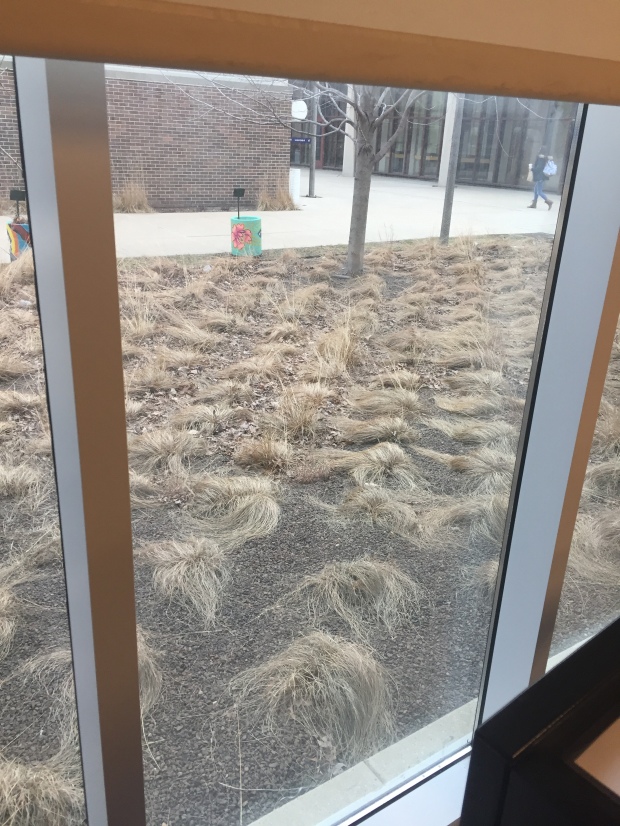
View Outside My Classroom Window. February 22, 2018. Photo by John Casey.
Greetings from Chicago!
Looking at my list of Blog Posts, I see that it has been since October that I’ve last written anything for this column. I guess the easiest way to explain that (aside from Holiday planning and travel) is that I didn’t have much to write about in those intervening months.
Today I decided to open my computer and write what will be my second to last post as Director of Anglophone/American Literature at NeMLA. My position ends at this year’s conference in Pittsburgh.
Before I launch into the topic for this post (the role of the imagination in literary studies), I just want to take a moment to thank a few people who have made my experience as Director incredibly rewarding. First, there’s Ben Railton, who put into my head the idea that I could self-nominate for this position and actually get elected. Then there are my fellow Director’s Susmita Roye and Lisa Perdigao both of whom I have had the privilege of collaborating with on Special Events programing. I learned a lot from their past experience. Thanks to Carine Mardorossian for being so patient with me as a newbie to NeMLA and to Brandi So who helped me with more than a few software glitch issues. Finally, I’d like to thank the members of NeMLA, without whom there wouldn’t be a need for a board at all. It’s been a privilege to serve you in the role of Director and a real treat to get to view the session proposals for the entire conference. Let no one tell you that literary studies isn’t strong as a field. It’s simply evolving (perhaps a bit slowly) to meet the times.
I hope to meet some of my readers in Pittsburg and hear the wonderful research projects you are working on. Remember to look for my signature bow tie. : )
Several semesters ago, I taught a version of a course on Literary Criticism and Literary Theory that began with a pair of essays. One was by Susan Sontag and the other by Jean Paul Sartre. In the first of these essays, Sontag decried the violence of literary analysis as it is taught in schools, ripping apart a work of art to see how it works rather than appreciating it for what it is–a mode of expression where the parts are greater than the whole and meaning can never fully be discerned. She made the daring claim that we should simply learn to emotionally engage with art as art rather than forcing it to mean something. Sartre, in contrast, argued that art and artists had an obligation to engage their audience to effect change in the world. (It’s not accidental that Sartre is probably better known and understood for his fiction than his philosophical treatises.)
These essays were meant to provoke a semester long conversation on what exactly this thing we call “literature” is and what as dedicated readers we are supposed to do with it. Not surprisingly, we came to no consensus on these issues. Here are how my thoughts have evolved on the subject since I first chose to introduce it in this class.
On the one hand, I find myself agreeing with Sontag. Poems, Short Stories, Novels, all the ways that humans can be creative are not like machines that can be ripped apart and studied for how and why they work. Perhaps the best critique of this reductionist approach to literature comes from Edgar Allan Poe when he explains his poem “The Raven.”
Yet, on the other hand, I can’t help but feel drawn to Sartre’s perspective that no form of communication is disinterested. Even artists want something from us.
How do I reconcile these twin beliefs? I focus on characters in fiction who become more real to us than the people we see on the streets every day.
This semester I am teaching an Introduction to American Literature course. I’ve always been committed to teaching works by lesser known and local authors. This spring I chose to meet that goal by teaching a course on Chicago Literature.
So far we have read poems by Carl Sandburg and Gwendolyn Brooks. Works by contemporary poets Eve Ewing and Kevin Coval are yet to come. We’ve also read novels by Theodore Dreiser (Sister Carrie) and Richard Wright (Native Son) and still have works by Nelson Algren and Bill Hillmann waiting for us towards the semester’s end.
Since our classroom looks out on the loop and the Sears Tower, it’s not hard for us to envision the world these writer’s create.
Teaching the Sandburg poem “Halsted Street Car,” I told my students to think of their morning commute. How many of us have seen the exhausted workers whose faces are “tired of wishes / empty of dreams.”
Reading Sister Carrie, I asked them to imagine her walking through the State Street shopping corridor, arm in arm with her dapper salesman boyfriend Charles Drouet. Who, I asked, are the Carrie’s they see walking that same street today? Where are the Drouet’s? The materialist desires both represent are far from gone. Otherwise, why would the stores still be there?
With Native Son, we reflected this week on the legacy of the Kerner Report and the growing number of black males in prison. I asked my students to find cases similar to that of Bigger Thomas and they delivered. I asked them to imagine what Bigger’s life would be like without racial barriers and we couldn’t. Even in our imagination he remained a criminal, just maybe not a double murderer.
Now as we move on to Gwendolyn Brooks, we are considering the role of black women in the worn out communities of the South and West Sides who are asked to hold the tattered fabric of community together against tremendous odds.
I see Sister Carrie and Charles Drouet, Bigger Thomas and his mother, Sandburg’s Contemporary Bunkshooter, and Gwendolyn Brooks’ Sadie and Maude and Chocolate Mabbie. I see them all when I walk the streets of my Chicago.
And what do these fictional characters become real mean to me?
First, they remind me to be careful. That it is easy for the imagination to wander into the realm of stereotype and through that engage in prejudiced actions.
Second, they remind me that although Chicago is a city that isn’t kind to fools and where a wrong turn can lead to a quick end, it is also a city of resilience and incredible kindness (especially among those who have nothing). Some of the kindest and most decent people I have meet are from areas in the South Side that outsiders are warned to stay way from.
And third, they remind me that the imagination is about envisioning what isn’t there or what might be and not simply a way to see “what is” in a different light. One persons’ realism, after all, is another person’s utopia.
As a teacher, I never know what my student’s will take away from my classes. Teaching literature itself can be as unpredictable as the art we examine. I do hope, however, that my students will think about the thorny issue of how “art follows life” and use that as a spur for action. To create the neighborhoods they want to live in rather than driving over the same damn potholes their grandparents cursed at.
Until Next Time….
John Casey
Director’s Corner (NeMLA Blog Post #21)
Posted by johnacaseyjr in Higher Ed, NEMLA, Updates on August 28, 2017
Greetings from Chicago!
The start of the fall semester is fast approaching and while I will miss the more relaxed schedule of my summer days, I am looking forward to meeting the incoming class of first year students at UIC. I often forget how unique my experience is on campus as I look out at a group of students who are truly diverse in terms of ethnicity, race, gender, and religion. These students teach me about what “America” is actually like and what it can be in the years to come even as I help teach them the literacy skills they will need to succeed.
Fall is always the busiest semester for me and this fall is no exception. I’ll be teaching four sections of Academic Writing I, the first class in the First Year Writing sequence, with a total of 96 students. This year I’ve decided to focus that class primarily on genre so that we can consider how the forms we choose to write in signal to our readers what we intend and shape the ways we use language. I also plan to consider how our language choices as writers can shift the ways in which readers understand a genre. Stay tuned as the semester progresses to hear more on how my writing classes are going.
In this month’s blog post, I’d like to consider the role of classroom design in the way that faculty teach. For those of us who read Inside Higher Education or The Chronicle of Higher Education, articles on the death of the lecture and the need for more active forms of student learning are commonplace. There has also been a resurgence lately in these publications of articles on the pros and cons of using technology in the classroom. What gets missed in most of these articles, however, is any real discussion of the actual classroom. How is it designed?
As with most form’s of infrastructure, the physical reality of the classroom is taken for granted. A board, some desks, a few square feet of floor space sufficient to cover max enrollment. Maybe a TV or projector system. But if colleges and universities want to change the way they teach, there needs to be greater emphasis on the spatial design of the classroom.
Traditional lecture halls were designed with a sloping or step down tier system. There also tends to be a curvature to these lecture halls. Students eyes are thus directed downward towards a common focal point–a lectern, chalkboard, whiteboard, or projector screen. Aside from the access issues these rooms present for physically disabled students, who might not want to sit all the way in the back or right up in the front, this traditional design sends a clear message about who is in charge and how knowledge gets distributed. Some faculty might try to counter this trend by using the room in a unique way, but the design can’t help but frustrate that intent. Group work and peer to peer discussion will always lead back to the focal point down below.
Rooms designed for a lecture/discussion format or a lab are a little better in terms of floor design. The floor space is flat and holds a smaller number of students. Some have fixed desks while others have movable desk and chair combos. Often, however, the square footage of the room prohibits a great deal of movement of these desks. It also takes considerable time and effort for faculty and students to rearrange desks for small group activities and discussion. The path of least resistance, therefore, is to leave them pointed towards the lectern, chalkboard, whiteboard, or projector. Student vision is distributed in a straight line but is still directed towards the professor. Thus turning the classroom on most days into a smaller lecture hall with a flat floor.
Of the two existing options in classroom design, the spaces allocated for lecture/discussion classes have the greatest potential for adaptability. They often, however, have too many students in them to make movement practicable on a regular basis. One solution, certainly controversial, is to reduce the number of students placed in these classrooms or at the very least to revisit how max occupancy standards are arrived at. On my campus, the Fire Marshall is the main factor determining this rather than pedagogical research. There is definitely a need for more research on the optimal number of students that should be in a room for a certain type of teaching method to succeed. This would give student advocates and faculty interested in changing to more active learning strategies some data to make their case for much needed changes. Right now, much of the discussion on this topic remains anecdotal and (therefore) gets ignored by campus administrators.
For those campuses lucky enough to have the money to build new classroom facilities, the issue is a different one. Should new lecture halls be built to create spaces for an evolved version of a venerable teaching method? Or should all new class space follow the call for more active learning (sometimes called a flipped classroom)? I’m of the opinion that new construction should contain spaces for all types of educational method currently applied such as lecture and lecture/discussion. New experimental spaces should also be constructed that allow for project based learning–small group activities and discussions. These spaces should imagine such active learning as on-going and not simply one method of using a lecture/discussion space.
This fall one of my first year writing courses will be held in an experimental classroom. It is a traditional lecture/discussion classroom that is being fitted with new desk and chair combos as well as touch screen monitors assigned to various clusters of desks. These monitors are supposed to allow students to work in small groups on assigned activities easier as well as discuss readings. The monitors are connected by a wireless system to the podium at the front of the room, which will allow me (should I choose to do so) to project what each group is working on up on the main projector screen for the entire class to see. I’m sanguine about what I’ll be able to accomplish in this set up with that group of writing students. As I get a better sense of what is different, I’ll let you know since I’m also teaching in three more traditionally designed lecture/discussion classrooms.
What I can say before I even get started in using the space, is that I’m afraid classroom designers (and some faculty) focus too much on technology (projectors and screens) as well as desks. The real focus (in my opinion) should be on square footage, focal points, and lighting. There should also be some consideration on storage for backpacks and winter coats as well as access to electrical outlets. For the experimental classroom I’m teaching in, I believe that racks will be installed under the chairs. We’ll see how that works. The electrical outlet set up will remain the same. Temperature of the room and wall color are also important. And, just as important, the room should make disability access seamless. Too often, the design of a classroom makes it feel like disabled students are being accommodated. They should be allowed to feel like the other students attending the class.
I hope that you all enjoy the waning days of summer.
Until Next Time…
John Casey
Director’s Corner (NEMLA Blog Post #15)
Posted by johnacaseyjr in Higher Ed, NEMLA, Updates on November 29, 2016
Greetings from Chicago!
Christmas music is now on the radio and stores are all decorated for the holiday season, but it’s 55 degrees fahrenheit outside. From my office window up on the 18th floor, I can see students sitting on the Quad in between classes enjoying their lunch and getting ready for final exams as well as a few students practicing their skateboard skills. This is the last week of class on the UIC campus. Next week begins exam week and a massive grading crunch for faculty as they scramble to get student work evaluated before leaving campus to celebrate the holidays with their families. I have a particularly busy December this year as my brother in law is getting married this weekend. After a whirlwind trip to Missouri to celebrate his nuptials, I’ll be back on campus to collect student writing and begin calculating final grades for my courses. Then I’m only in Chicago for a few weeks before heading off to Vermont to visit my family.
For this month’s blog post, I’d like to take a moment to consider the concept of the “public intellectual.” Public Intellectual is one of those terms that generates highly polarized responses. Some people see the term as reflecting a healthy engagement between faculty and the general public. Others see it as patronizing, an attempt by elitists generally sheltered from society, to meddle in the affairs of people they don’t understand. These polarized responses to the public intellectual indicate two things to me. First, academics are bad at communicating with people outside their areas of specialization, justifying the charge of being patronizing. Second, academics don’t have a clear sense of the social value of their work.
Let’s start with the issue of communication. Last semester I had the privilege of teaching ENGL 240, a course in literary criticism and critical theory designed to prepare English Majors for upper level surveys and seminars. One of the frequent topics of conversation between me and the students in that class involved the density of the language in the texts we were reading. Many of these texts used jargon from disciplines outside of English such as philosophy, economics, and sociology. They were also often poorly translated from their original languages (typically French and German). When students would complain about the difficulty of something we were reading for that class, I would point out to them that sometimes a text is complicated to read because the concepts examined are complicated. However, sometimes complexity of language is an attempt to make something simple sound complex. In my teaching, I instinctively gravitate towards making complexity understandable for novices just learning how to read and write about literature. Yet when I write, I feel compelled to mimic the structure and tone of the experts in the field that I assume will be reading and critiquing my work. Often this means adopted the tortured syntax and vocabulary of “theory.”
Adapting your writing to meet the needs of a specific audience is not a bad thing. I teach students in my rhetoric courses to always keep audience expectations in mind as well as pay attention to the rules of genre. But it’s not always easy to shed the jargon, lengthy sentences, and analytical backflips so common in academic journals and books when speaking to non-academics or even to faculty outside of your own field. I remember a History professor telling me once that the worst books he had ever read where written by English faculty who seemed to think that complex syntax and jargon could substitute for critical insight. Although I tend to agree with that critique and write in all my work as directly as I can, the issue of “code-switching” seems more relevant to me. Often applied to multi-lingual speakers, code-switching describes the ways in which we adjust our language to meet the expectations of our audience. It also recognizes the relationship between language use and membership in a wide variety of social groups. Lecturing is not just a technique. It is a tone of voice. To have a conversation with the general public, some genuine code-switching is in order. Speak to people in a tone that doesn’t deny your status as an expert but that also doesn’t deny the expertise of those to whom you are speaking. Everyone is an expert in something. Share that expertise.
Moving on now to the issue of the social value of academic work, the problem varies from discipline to discipline. In my own field of English studies, the problem has arisen that no one is clear anymore on what counts as literature, why we should read it, and how we should talk about it after it is read. It is kind of a paradox that our abundance of creative writing is paired today with the lack of an audience. Particularly an audience that knows what to do with creative expression. My approach to the problem has been to contextualize creative expression in the classroom and in my publications. I try to help students see the factors that went into the production of a piece of literature, including the cost of printing and purchasing a book, and also to consider the responses of prior audiences when they read a work of literature. We then discuss why we believe that a book remains a subject of discussion as a way of answering the “literary question.” I also engage in the thorny issue of evaluation (i.e. Is the book really any good?). In my publications, I also contextualize the works I examine but I tend to assume the “literariness” of the material I analyze. Since I’m writing for experts, I assume that they will see the works I examine as worthy of examination. Particularly since other scholars have already written on the authors I am analyzing.
None of this addresses the problem, however, of how to convince the general public to see the value of your scholarship. For me the essence of the problem is how to create the kind of spaces outside the classroom that mimic some of the elements of what I do in the classroom. Public lectures like those held by Emerson and Twain in the 19th century are rare today. As are book clubs. Thus far, my only answer to this dilemma has been to blog. My blog posts serve as a quasi-lecture series for the general public. I’ve also offered book reviews on occasion in my blog for academic works related to my field hoping that some non-experts might be tempted to read those works. Obviously, however, this is not enough. What is needed is a recommitment to the concept of lifelong learning. Faculty need to become more engaged in what remains of their campus extension programs and courses for adult learners who are auditing courses rather than pursuing a degree. Improve what is there and expand it. We also need to become more comfortable on television, radio, and other forms of media not commonly used by experts to speak to other experts. Who among us is brave enough to be the Bill Nye or Neil deGrasse Tyson of the humanities?
I think I’ve said enough for this month’s post. But a long post is in order since I won’t be writing to you this December. I’m taking the month off to celebrate Christmas and New Years. I hope whatever holidays you celebrate are enjoyable, spent with family and friends. I look forward to continuing my communication with you, my readers, in January.
Until next time…
John Casey
Director’s Corner (NEMLA Blog Post #14)
Posted by johnacaseyjr in Higher Ed, NEMLA, Updates on October 31, 2016
Greetings from Chicago!
The leaves are starting to change color on campus and there is a chill in the air. Fall is slowly coming here to the windy city. We’re now more than half way through the semester at UIC and it shows on the faces of students and faculty. Everyone is ready for a break. If nothing else, it will get us away from the constant noise of construction that follows us from one space on campus to another. In the meantime, we press on.
My last blog post focused on my research. This one will be a bit of a grab bag. One of the major downsides to being a Full-Time Nontenured Faculty member is the lack of time for research. This semester I’m teaching four First Year Composition classes and its hard to find time in between course prep, grading, and meeting with students to read the sources I’ve collected from the library for my second book project. Right now, I’m slogging my way through an economic history of farming written by Willard W. Cochrane. His text is giving me a useful overview of the shift in farming practices over the course of US history. Careful notes are helping me remember where I left off each time I set the book down to counsel a student on the best way to format a literature review. I recognize, of course, that having any time at all to research is an oddity for most NTT Faculty, especially those who teach part-time. My situation as a Lecturer is far from ideal, but it is certainly an improvement to the days when I was paid by the course and had to travel in between campuses.
As with most things in life, the academic profession is a series of pluses and minuses. The minuses for me are the stagnant pay and lack of research opportunities. The pluses are the security of a yearly contract, benefits, course schedule, and now an increasing recognition of my past research on campus. It might not seem like much to outsiders, but my being assigned to teach a section of the Sophomore level American Literature survey (ENGL 243) is a major advancement not just for me but a sign of how work conditions are improving for NTT faculty in our department. I’ve also been invited to a faculty author’s reception hosted by the UIC Chancellor’s office to celebrate the publication of my first book (New Men) last year. This also is a major advancement in NTT conditions on campus since I was not recognized for a long time as a faculty member. Finally, there’s the fact that I am writing this blog as part of my duties as Director of American Literature for NEMLA, a position that has traditionally been held by TT faculty. So life is not all gloom and doom for those off the tenure track. Progress, I often have to remind myself, is incremental and not necessarily linear. I continue to advocate for NTT faculty and for nontraditional students on campus, planting seeds for trees I will probably never see fully grown.
Part of what has helped me become more integrated into my campus is hutzpah. If there’s something I’m interested in, I find a way to get involved. This was the case with a recent event discussing the construction plans for a new classroom building on the UIC campus. I saw the faculty massmail advertising the event and showed up, the only English faculty member and probably the only NTT faculty member in the room. The usual types were well-represented, of course, various Vice-Chancellors and diverse Deans of subject areas few can adequately comprehend. There were also a few TT faculty from Math and Chemistry as well as Engineering and Social Sciences. During this session, the designers explained the overall goal of their plan. They want to design a classroom that encourages “student-centered” learning. Normally phrases like that give me the creeps. They have this “edu-speak” ring to them that is common amongst folks who talk a lot about education but have never stepped into a classroom. This presentation, however, held my attention because it focused on how the physical design of a classroom might change (in a positive way) how faculty teach.
Physical design of classroom space at UIC is a frequent topic of conversation among our faculty. Usually in the form of complaints about how a classroom’s designs prohibit us from doing the type of teaching we would like to do. For years I’ve wanted to experiment with multi-modal composition in my writing classrooms but have been stymied by the lack of a good computer and projector to exhibit projects, poor wi-fi reliability, and classrooms that are too small for students to move around in comfortably to work. Our buildings at UIC were designed for an era when the lecture was king. In spite of our best efforts to increase the discussion/activity functions in teaching, the rooms often lead us back to the lecture because it’s easier to do so. So what would a class that makes lecturing hard if not impossible look like? I saw a few examples of this in the presenter’s mock up drawings.
The example most relevant to the size of the courses I teach (18-25 students) was a room that could hold a maximum of 35 students. That room had a white board in the front, a fixed computer podium, projector and interactive screen (i.e. a screen you can write on with dry erase markers). Students sat at square tables made from joining together two rectangular ones. Four students to a table. These were arranged throughout the room. On the side walls were touch screen televisions that could be used by students for break out sessions. Each television was connected to the main projector in the room as well as to the internet.
The whiteboard, podium, and projector set up still make it possible for a faculty member to lecture, but it is harder for students to see the material. They need to move around because they don’t sit in fixed rows oriented towards the front board. The room is also longer than it is wide, making it difficult to project your voice from front to back. Consequently, this room discourages faculty from talking to the class as a whole and encourages them to move away from the podium to walk among their students and check in with individual groups. This is something that I already try to do in my composition classes. The square footprint of our classrooms, however, make it harder for me to do this. The room fits exactly 24 students (according to fire code) and that is the number I have. Add backpacks and winter coats and it soon becomes impossible for anyone to move about in the room. A 35 person room with 24 students in it would be like heaven. Adding technology to the room and more natural light would simply be a bonus. I can imagine providing students in a classroom such as this with a task to complete in a set period of time. I would then check in with each group as they work and show the entire class particularly unique methods to addressing the task.
Of course, there are obvious drawbacks to the design proposals I saw. One is the assumption that all our students have laptops or tablets that function like laptops. The digital divide is real on our campus and is only slowly being addressed. You can’t complete homework assignments on a smartphone even though many students try to do this. Another is maintenance. Lincoln Hall is currently one of the most advanced classroom buildings on our campus and its technology is fast becoming outdated and very beat up through heavy use. I’m constantly having to reconnect or jiggle loose cables and find adaptors to connect new devices that no longer have VGA or standard sized HDMI ports. Finally, design alone cannot drive pedagogy. It can force us to think more carefully about how we teach, but only faculty meeting with other faculty can hash out what the role of the lecture should be in each course and discipline and how it should relate to more active learning techniques.
All of this brings me to my conclusion for this post, which is a question. What does your ideal classroom look like? Mine would be large enough to have zones for distinct modes of learning. One zone would have a circle of desk/chair combos near a white board for lecture/discussion. Another zone would have tables and chairs for writing and research. And yet another would have comfortable chairs for students to sit and read, thinking through their understanding of a concept. Students could move freely through this space depending on what task they needed to accomplish. My syllabus would reflect this. Each day would emphasize a certain mode of learning and blend them together as needed. At least one wall would provide natural light that could be filtered or blocked to allow showing films and videos. There would also be ample storage for student backpacks and coats so that they don’t have to be placed on the floor.
Multiple focal points in a room. Multiple modes of learning in a syllabus. These are my goals. We’ll see if the new classroom building UIC constructs makes this possible. In the meantime, we make do with the tools at hand.
Until next time….
John Casey
Director’s Corner (NEMLA Blog Post #9)
Posted by johnacaseyjr in NEMLA, Updates on April 28, 2016
Greetings from Chicago! The spring semester is almost over and faculty and students are preparing for summer break. Of course, it feels more like winter here today as the temperatures in the city will be lucky to reach 48 degrees. A good day to stay indoors and read.
Don’t forget that tomorrow is the deadline for submitting a session proposal to the NEMLA 2017 conference in Baltimore.
Information on the types of sessions you might propose for the conference can be found here https://www.buffalo.edu/nemla/convention/session/sessions.html .
You can propose your sessions on the CFP website via this link https://www.buffalo.edu/nemla/convention/session.html.
In my last post, I combined a recap of the NEMLA 2016 Conference in Hartford with an examination of the broader theme–Why Write? This theme seemed to dominate the conference sessions I attended. This month I’d like to consider the related questions of how and why we read.
How we read in and out of the classroom was a question that came up frequently during the round table session I chaired in Hartford on reading American Literature with Digital Texts. We looked at some of the formats in which electronic texts are distributed and how close reading techniques such as annotation can be used with them. One of the more interesting trends explored was the use of software that allows collective annotation of electronic texts, specifically Lacuna Stories . I’m not totally sure how to use this software, but it does seem to address what has long been one of my concerns with electronic texts. Reading in the context of an English class requires an attention to language that goes beyond scanning a webpage for content. We often call this special type of reading “close reading” without really thinking much about the mechanics involved in the process, aside from reading a text multiple times. Annotation, however, is the crucial difference between casual reading and reading with a purpose. Lacuna Stories allows this process to transfer from the analog to a digital environment. Even more importantly, it allows students and faculty to share those annotations (or not) and learn from each others reading process. This is a great example of using technology to achieve a goal that might not be possible in an earlier classroom setting.
But why do we read in the first place and is there any connection between this activity as it happens outside the classroom as well as in? I’ve been thinking about this question a lot because I’ve been teaching ENGL 240 this semester, Introduction to Literary Criticism and Critical Theory. This course is required for all English majors and minors at UIC and it is presumed that this will be among their first English classes, preparing them for upper level surveys and seminars. Finding a baseline for teaching students in this class is very difficult, as each student comes with a varied educational background. Some of my students are transfers from community colleges who have extensive knowledge of how to read and write about fiction. Others are just out of high school and haven’t read much fiction at all. Add to that the groups of students who speak English as a second language and those who are interested in an English major or minor predominately for Professional Writing skills (Corporate Communications, Public Relations, Journalism, etc.) and you have an almost impossible task staring at you. First, to find out what prior knowledge this diverse group of students possesses and then to devise a course plan that works to build upon the commonalities in what these students know.
What I’ve found this semester, is that my students don’t read much fiction at all. They watch a lot of fiction. They even write a considerable amount. But reading fiction, not so much. This even includes what we might refer to disparagingly as “fan fiction” or “pulp fiction.” My students watch their stories rather than engage them through the written word. The challenge for me this semester has thus been to turn their attention to the written word and explain what to do with a fictional text (i.e. close reading) as they read. Oddly enough, this experience has felt a lot like what I experienced studying Latin and Greek at UVM during my undergraduate years. An intellectually stimulating exercise that in large part felt separated from the world around me. I could escape for a few hours into the world of Livy, Vergil, and Catullus and not worry about current events.
I realize that at this point I’m starting to sound like “that” professor, vaguely luddite, who laments their student’s inability to perform at a level they deem acceptable. If you read The Chronicle of Education at all, you know the type. My colleagues have even asked me when I talk to them about the problems I’ve faced getting students to read carefully: How is this any different from the way things have always been?
My answer is, I don’t know. Perhaps this problem has always been with us, but I feel like something has shifted. I’ve taught at UIC for 15 years, part of that as a Graduate Student Instructor and part of that as a Lecturer. During that time, the baseline I can assume for student knowledge has shifted away from text based narrative to alternative forms of storytelling. In the meantime, English pedagogy has generally stood still. That’s why what I’m teaching students feels more like Classics than English.
I continue to teach students how to read written language carefully in spite of my doubts and concerns because I believe in the power of imagination and the written word. Most of the communication we encounter on a daily basis is obsessed with utility and the way things are now or could be in the near future. Fiction (at its best) opens the door to a world we hardly thought possible. It looks beyond the far horizon and asks Why Not? My understanding is that University studies should prepare students to create a world that doesn’t yet exist rather than replicate the one that we have or tweak its existing parameters. Fiction is crucial to that task. And nothing, in this bibliophile’s opinion, makes that possible like sitting down and immersing yourself in a good book.
Now that I’m finished writing, I think that’s what I’ll do next.
Until Next Time…
John
Director’s Corner (NEMLA Blog Post #6)
Posted by johnacaseyjr in Higher Ed, NEMLA, Updates on January 28, 2016
Greetings from Chicago! It’s cloudy and cold outside today as I sit and write this blog post but unlike the east coast there’s no snow on the ground here. Perhaps I’m crazy, but I kind of miss the snow cover. Haven’t had a chance to drag out my cross country skis at all this year.
My last blog post was written before Christmas. I hope you’ll forgive me for taking the month of December off as I was focused on visiting my family and trying to wrap up a bunch of projects that had collected on my desk over the fall semester. In that November post I examined the use of electronic texts. This post will cover the topic of Educational Technology.
I first became aware of the term “Educational Technology” through Twitter, specifically the tweets of Audrey Waters. Before reading some of her posts on Hack Education, I had never heard of the term but I was well aware of the programs and services the term described. Most familiar to me is Blackboard, the Course Management System (CMS) used at UIC. I was also familiar with the various products such as MyWritingLab that Pearson had long been promoting amongst writing faculty on campus. Apparently they have a version of this My(fill in the blanks here)Lab for every discipline taught on campus.
Most faculty entering the market for Educational Technology are either lost in a field of options made more confusing by technical jargon or are simply content to accept whatever technological tools are provided to them by their employer. Few of us have the time or inclination to ask what types of technology are cost effective and, more importantly, what tools will actually enhance what we do in the classroom.
I experimented with several different types of educational technology in my First Year Writing classroom during the Fall semester of 2012. The course I was teaching (ENGL 160) is designed to teach students short genres of writing such as the argumentative essay and proposal writing. At the time, the course was balanced between academic and non-academic genres. You can find a link to the syllabus under the Teaching Materials tab of my website. It’s called “First Year Writing:Genre and Argument.”
I chose the Profile genre as well as that of the Manifesto to help students practice writing in a public context. Since many of these non-academic genres are published online, I decided to have them work on the text of their assignments in Microsoft Word but then import that content into Google Sites for the Profile and Tumblr for the Manifesto. Neither of these tools are typically considered educational technology, but that is part of my point. Marketers have software and services that they claim are designed with your classroom in mind. But any technology can become educational technology if you provide the proper pedagogical context for it.
In the case of the Profile, Google Sites was chosen as a simple web design tool that would allow students to craft an online Profile for the person they interviewed. This person was someone on campus at UIC that they felt others should know. My favorite example was the student project that focused on a custodian in her dorm complex. The hope with this writing assignment was that students would not only learn basic rhetorical techniques associated with the Profile genre since its creation but also would learn how to translate those analog skills into a digital environment. It worked generally OK. My one frustration was with my choice of platform. Google Sites proved easy to me, but not my students who struggled to figure out its design interface. Tumblr was a different story. Most of my students had already used Tumblr before and some had profiles on the site. They also like the photographic emphasis of the platform as opposed to the text heavy set up of Google Sites. They used Tumblr effectively to create a Fashion Manifesto (based on the popular Sartorialist blog) that was designed to teach UIC students how to be fashion savvy on campus.
This academic year our program has begun shifting to primarily academic forms of short writing. I haven’t taught this particular course in a while so I’m not sure how that would shift my choice of educational technology. One thing is for sure, however, I like choosing and shaping the tool I want to use rather than simply taking something given to me by an educational technology designer. This saves students money but is also gives me flexibility as an instructor to shift from platform to platform as I see fit rather than being locked into a deal with a major publisher or software developer whose staff don’t fully understand the needs of my class. The downside to this approach, as I’m sure you’ve already guessed, is that it does take a bit of time to create your own context. Perhaps that’s why I’ve stepped back from the process of platform selection in the last few semesters to more traditional pedagogical tools. I’ve even tried, Lord help me!, to make Blackboard work to my advantage. No luck on that yet. It still serves mainly for me as a clunky version of Dropbox.
Faculty on campuses around the world are doing some excellent work with their students creating their own educational technology. Two that come to mind are Chuck Rybak at the University of Wisconsin Green Bay and Jeff McClurken at the University of Mary Washington. There are many more. What these faculty have in common is a desire to learn the logic behind technological tools and create a context for them in the work they do in the classroom. Again, this takes time. It also takes money and at the very least a minimal amount of institutional support. Unfortunately, at my institution security concerns and legal liability issues trump the desire for experimentation. As I often joke with colleagues, the answer to any question asked of our university computing center is “Blackboard.”
For anyone reading this post who’s interested in delving into the world of educational technology I recommend first finding a partner to work with. This could be either another faculty member in your department who shares some of your interests, a colleague in a department such as computer science who would be interested in collaborating with a humanities scholar, or a librarian willing to help you create your own educational tool. Not only will this save you time, but it will address the issue of funding, which is always a concern with new projects. Free online tools are abundant but not always easy to find. Adapting these tools might also cost you some money for things like hosting fees and access to advanced editing tools.
What I don’t recommend is simply taking the tools offered by educational companies and using them in your classroom. Blackboard is useful. Especially the announcements, file sharing, and grade book. But using it teaches me nothing. Nor does it teach my students. All it does is deliver content. The point of educational technology should be more than content delivery. It should be the act of learning how to deliver content through an electronic medium (a.k.a. digital literacy).
I hope you all find the tool that works best for you and don’t get distracted by technology that you don’t need. If you are a faculty member and have some tools that you particularly like or educational technology projects you’re proud of and would like to share with my readers, feel free to comment on this post.
My next post is going to shift from pedagogy to research. I’ll be sharing with you some of the themes associated with my next book project. A work very much “in progress.”
Until next time…
John Casey
Director’s Corner (NEMLA Blog Post #5)
Posted by johnacaseyjr in NEMLA, Updates on December 1, 2015
I hope that you all had a Happy Thanksgiving and are on track for a successful end to your fall semester. After getting back from a visit with my in-laws in Springfield, Illinois, I find myself swimming furiously in a sea of student papers, articles and manuscripts in need of peer review, and revision of my own writing. There’s also the constant rush of students in and out of my office now that they’ve discovered (belatedly) the location of my office as well as my posted office hours. Ah, the glamorous life of the academic. ; )
In my last blog post, I focused on the use of Twitter for academic purposes. This month I’d like to discuss the use of electronic texts in the classroom. Among my colleagues at UIC, there is a robust debate over whether it is appropriate at all to invite the use of electronic devices in the undergraduate classroom. Some faculty choose to prohibit phones, tablets, and laptops from their classrooms and require students to purchase hard copies of books and print out articles for discussion in class. Other faculty on campus only use electronic texts, print sources than have been scanned or coded into an electronic format or sources that only exist electronically.
My approach is a hybrid of these two poles. Certain books I prefer to have students buy in hard copy or print out. These are typically sources that we will be reading closely or analyzing multiple times. Other resources, mostly contextual in nature, I prefer students to access electronically as needed. The rationale behind this decision does have some research to back it up, but is based largely on my teaching experience as well as feedback I have received from students. “Close reading,” “Analytical Reading,” “Hermeneutics,” call it what you will, depends upon a form of deep concentration that it is hard for us to achieve when we are scrolling up and down a computer screen. True (as Franco Moretti points out) readers have been engaged in superficial readings of texts for as long as humans have been writing language down. However, it is just too easy for me to shift to Facebook, Twitter, or another document when reading an electronic text or skim rapidly across the words on the screen without registering much beyond the “gist” of what I have read. With a book or article in hand, I feel pressure to go back over text my eyes have lazily gazed over and highlight/annotate the parts of the text that seem significant.
Students in my courses have generally agreed with this assessment. Contra Cathy Davidson whose most recent book, Now You See It, champions the benefits of distraction, students on the UIC campus have complained to me about how hard it is to focus with their phones buzzing and pinging with updates and notifications from various apps. They have also found the technological limits of wifi, software compatibility, and device battery life a challenge. We joked in my Introduction to Literary Criticism and Theory course several semester’s ago that the main vulnerabilities of the codex as interface are water and fire. Other than that, as long as you don’t lose the book or print article, you’re good to go.
These significant drawbacks to the electronic text have often left me skeptical about the best way to use them (if at all). As I mentioned earlier, the main ways in which I have found electronic texts useful have been contextual in nature. This includes bringing historical documents such as newspaper articles, letters, photographs, and maps into the classroom. These supplementary texts help us better understand the social background of the writings we are analyzing. Another effective use of electronic texts has been when a work is otherwise unavailable in print for students to read. Most of the authors I teach and research are now part of the public domain, making their work freely accessible for all to distribute in whatever way they see fit. What better way to appreciate the literary context that influenced an author’s aesthetic than to read the works of his or her contemporaries for comparison.
Perhaps the greatest source of influence in my decision on whether or not to assign an electronic text, however, has not been pedagogical at all. Instead it has been driven by the rising cost of student textbooks. The anthology I used in my Introduction to Literary Criticism and Theory cost students on average $115 to buy. Renting the book lowered the cost to around $70. This might not seem like much in comparison to texts in other courses that can cost significantly more or software programs that students are required to buy for majors in the architecture and the sciences. Yet the cost adds up over time. Whenever I assign a print book or article, I make sure that we are in fact going to read the text exhaustively. That it is in ever sense a “required” text for the course. Anything that might even be vaguely considered supplemental, reference oriented, or “recommended” is assigned in an electronic format to save costs.
Now at this point it is worth acknowledging the hidden and often not so hidden cost of e-texts. Publishers come by my office on a near constant basis around this time of the year, particularly Pearson. They are more than eager to sell my students access to proprietary websites that mediate between them and the things they will be reading. One example is MyReadingLab. The allure of such technology is that it lessens my workload in and out of the classroom. But is it worth the cost? To me, at least, it isn’t. I would rather find online resources that are either free or more affordable and link students to them via our course management site, Blackboard. There is also the transfer of costs to students in printing fees, my xerox budget has been cut dramatically by my department, as well as the cost of buying a device to read electronic texts on. Sure, a sizable number of our students have smartphones today, but who wants to read a novel on a iPhone? Even youthful eyes are strained reading that tiny print.
The only honest way to conclude a discussion of electronic texts in the classroom is to admit that the data is mixed. Their are numerous disadvantages to moving away from print texts but there are also many benefits. I hope to have a fruitful discussion on both during my round table presentation in Hartford on “required texts” and “authoritative” editions of literary works. In the meantime, if you have been using electronic texts successfully or unsuccessfully in the literature classroom, let me know. If you haven’t tried using them at all, experiment with a few this spring. Teaching and scholarship after all are a great adventure. Why else would we keep slogging along through the seemingly endless writings by students and colleagues that call for our attention on an almost daily basis?
In my next blog post, I intend to revisit my comments on Pearson and other educational resource providers (including Blackboard). What should scholars know when they enter the market for educational technology? How can we choose the tools that make sense for our pedagogy when we are limited by lack of knowledge, money, and sometimes institutional bureaucracy?
Until next time….
John Casey
Director’s Corner (NEMLA Blog Post #4)
Posted by johnacaseyjr in Updates on October 30, 2015
Greetings from Chicago! It’s starting to look and feel like winter a lot more with each passing day. Colorful hats and scarves are coming out of storage and adding to the beautiful colors of the fall foliage on campus. Here’s a picture I took this weekend of the signs of fall slowly turning to winter at UIC. Hopefully you’ve had a least a few sunny days wherever you are.

In my last blog post I began to discuss issues related to teaching with technology in the field of American Literature. This month I’d like to move from blogs, a fairly well-established medium at this point, to the newer and more contested form of micro-blogging that is best exemplified by Twitter.
What can you do in 140 characters or less? This was the question I set out to answer in August of 2011 when I signed up for Twitter. Here is a summary of what I learned:
- You need to choose the people you “follow” carefully
- It’s easy to get into fruitless arguments with people you don’t know
- Networking via Twitter is haphazard.
Let me start with the first of these observations. The reason I say that it matters who you follow is that this decision dictates your Twitter “feed.” When you “follow” someone on Twitter, you tell the service to send you everything that person posts. This might include photos, things they have written, or materials they forward to you from other people (known in Twitter lingo as “retweets”). If you plan to use your Twitter account primarily for academic purposes, it makes sense to follow faculty whose work you admire, programs that are producing materials you find useful to your own work, or institutions that contain primary sources you frequently use. You can also add the accounts of colleagues in other fields and keep up with research happening in areas of study not directly related to your own. When you choose the people you follow carefully, your Twitter feed ends up looking like a newsletter (updated each day) or an interactive RSS list. If the headline grabs your attention, you can then click on it and learn more about new research, job changes, grant and positions available, etc. Most complaints I’ve heard about Twitter feeds involve users who want their account to be simultaneously personal and professional. You can try to do this, but (unlike on Facebook) I don’t think it will work. Tweets from the National Archives and faculty on United States Civil War era culture don’t mesh well with the latest pronouncements from celebrity land. Save the Kardashians for a personal Twitter feed or for scholars in contemporary pop culture.
Focusing on my next observation, writing in 140 characters or less is an exercise in precision. You need to eliminate all unnecessary words as Twitter won’t let you send out a message that is longer than its software allows. (This might change in the near future, but for the moment the limitation stands. More on the shift in Twitter’s function later.) I have used Twitter in my college composition classrooms as a way to teach summary to students. It can also be a useful grammar teaching tool if you force people to Tweet grammatically correct statements with no text speak or emojis. Of course, this haiku like brevity also leaves plenty of room for misunderstanding. I learned this the hard way not long after I joined Twitter. My assumption was that hardly anyone would read my tweets. I am not famous after all, just a Lecturer in English at a midwest regional university. Following this logic, I vented my frustration with the Modern Language Association (MLA) on Twitter. Imagine my surprise when the Executive Director of the MLA (Rosemary Feal) responded to my tweet. Not only did she respond, but she was hurt by the critique contained in my message. After trying to explain myself via multiple haikus (a.k.a. tweets), I gave up and moved over to a new medium (a blog post) that seemed better suited to the complex nature of our disagreement.
My experience with the knee-jerk nature of disagreement on Twitter is not unusual. What is unusual is the positive outcome to the interaction. Many have begun to use the medium as a way to bully others into silence. Although any tool can be used for a similar purpose, including the telephone, Twitter seems particularly vulnerable to this type of manipulation. Twitter, as many analysts have claimed, is a tool for “amplification,” getting one’s message out to the broadest audience possible. What gets amplified sometimes fills me with disgust.
Getting into a Twitter fight so early in my use of the medium has shaped my usage of it since. Someone who has studied the medium much closer than I have has observed that there are typically three types of people on Twitter: the lurkers, the reposters, and the networkers I began as a lurker, simply reading the tweets of others. From there I attempted to be a networker, only to be shot down for speaking up. Since that moment, I have been mostly a reposter. A quick glance at my Twitter feed will show that I don’t write much content on Twitter. I repost the materials of others that I think might be useful or interesting to other people. I also post links to my blog, which is where I do most of my talking. Twitter (as I use it now) amplifies the works of others and also publicizes my own.
This leads me to my final point. Just as I thought that blogs would help me to network with scholars I could never meet in person, I also thought that Twitter would help connect me to scholars whose work I admired from afar but would never meet at an academic conference. That hope didn’t pan out. As with blogs, I learned that face to face networks tend to have a greater impact that virtual ones. It was only in a few instances where virtual networking proved to be relevant and lasting. Mostly it’s like throwing darts in a dark room. Twitter is a good supplement to old fashioned networking, but it is a supplement rather than a replacement. Not great news, I’m afraid, for adjunct faculty.
By way of conclusion, I’d like to discuss the issue of how Twitter has changed since I joined in 2011. Twitter remains a free service, but went public in 2013 and now trades on the New York Stock Exchange. As with Facebook, the decision to become a publicly traded company has altered the nature of the medium. Ads and “promoted tweets” now flood my feed and often drown out the ones that are more relevant to me. A new “moments” feature has also been added to the mobile version that sends me the top news stories of the day in a feed format that looks a lot like Facebook. There has even been discussion about changing the 140 character limit, allowing longer messages. In a struggle to be profitable, Twitter is killing off what made the service unique in the first place.
Twitter has become less a newsletter and more of a billboard. At the same time, the aggression directed at some of the most vocal communicators on Twitter has shut down meaningful discussion through the medium. Legal attention to faculty tweets (particularly those of Steven Salaita) has also had a similar silencing effect. What began for me as a virtual seminar, teaching me enormous amounts of information on what came to be known as Digital Humanities, is now just another news aggregator.
I hate to end on a down note, but I have to be honest about my experience with this particular tool. Keep in mind, however, that this is just my experience of Twitter. It’s still free. Try it out. Discover for yourself how or if it makes sense to communicate your scholarship in 140 characters or less.
Next month I’m going to discuss the pros and cons of using electronic texts in the classroom, a prelude to the topic I’ll be presenting in Hartford. From there I think it makes sense for us to consider our vulnerability as scholars entering the market of educational technology.
Until next time…..
John Casey
 John A Casey Jr