Archive for category Updates
Director’s Corner (NEMLA Blog Post #8)
Posted by johnacaseyjr in NEMLA, Updates on March 25, 2016
Greetings from Chicago! After a cold, wet day filled with rain and snow, the skies have cleared today and the sun is out. Birds are singing and, dare I say it, Spring feels like it is soon on the way. Hopefully there are signs of Spring wherever you are.
This month’s blog post is dedicated to a recap of the NEMLA 2016 conference, which this year was held in Hartford, CT. My first conference as American/Anglophone Director was an exciting experience as I had the opportunity to participate in and hear panels on a wide variety of topics. Now past-President of NEMLA, Ben Railton, also added to this year’s convention an exciting new element as scholars reached out to the community (especially high school teachers and students) to discuss issues of importance to us as thinkers and educators. These community centered events were mostly held at the beautiful Mark Twain House, just in view of Hartford High School, although a number of scholars went to schools around the city to visit students.
Race, immigration, and the ongoing specter of “terrorism” were common themes across convention panels and special events. Jelani Cobb, Professor of History at the University of Connecticut, gave a powerful keynote address on how the events of the past few years have all but shattered the notion that the United States is a “post-racial” nation. His contextualization of race relations in American culture challenged all of us in the room to find a way to create engaged scholarship that encourages our colleagues and students to move beyond the standard narratives used to describe race in American culture while continuing to work for racial justice.
Academic conferences are so large that each person’s experience of them is unique. Beyond the larger themes I noticed in this year’s convention, there was an undercurrent to the sessions I attended that brought me back to a question central to the study of literature. That question was Why Write?
At the Special Event for the American and British areas of NEMLA, Porochista Khakpour, currently a writer in residence at Bard College, answered that question in a wide variety of ways but kept coming back to the reality that often we write to survive. Creative people, and I would like to think that all of you are creative people, feel a deep need to explain their experiences to others. This desire often presses up against our resistance to explain. In Khakpour’s case that resistance stemmed from her frustration at being constantly asked to explain what it means to be “Iranian” and what it’s really like in Iran. Fearful both of cliche as well as over-exposure of personal treasures too precious to share with just anyone, Khakpour described her writing process as a constant push pull between the stories inside her that demand to be told and the pain of telling those stories. Yet the telling of those stories, as the conversation after the talk made clear, brings us closer together as humans who ultimately have more in common than talk of our ethnic, racial, and sexual divisions might suggest.
Melissa Tantaquidgeon Zobel discussed this issue of writing to survive in a different context. A member of the Mohegan Tribe, Zobel’s life and writing belies the myth, propagated by James Fenimore Cooper among others, that Native Americans are either vanished or in the process of vanishing. Her fiction, most of it aimed at Young Adult readers, works towards the goal of helping young Native Americans of whatever tribe to make sense of their ancestry. Ironically, this is a goal that touches me personally. I shared with Zobel towards the end of her talk that in middle school I went an assembly in the school gym where we heard the stories told by Abenaki historian and writer Joseph Bruhac. If you’ve ever met Bruhac, he is a very engaging storyteller and I couldn’t help but share with my mother how excited I was to hear him tell his tribal tales. She then told me that her mother, my maternal grandmother, was Abenaki from the St. Francis band of the tribe in Quebec. This surprised me greatly at the time and still does. It was another example from my personal history of the problematic concept of “authenticity.” My identity is composed of at least six different ethnic identities, not all of them unambiguously white. Which one is the authentic me? This question is especially difficult as to the eyes of the world I’m just “white.” Zobel’s characters struggle with issues of mixed-identity in their own ways. I look forward to reading more of her work as I’ve just started reading Wabanaki Blues.
I could give many more examples of the ways in which presenters addressed the question of Why Write, but the two above made the most lasting impression on my mind while the others remain shadows at the margins of my memory. If you had a sense of a theme linking the sessions you attended at NEMLA 2016, feel free to comment on this post. As I said before, the experience of a conference as large as NEMLA is highly subjective.
With Hilda Chacon, Professor of Spanish at Nazareth College, now serving as NEMLA President, I look forward to an equally engaging conference in Baltimore, MD in March of 2017. The Call for Sessions is now live for the 2017 conference. If you have a seminar, roundtable, or panel to propose, you can do so here http://www.buffalo.edu/nemla/convention/session.html.
Sessions are welcome in any area. As American/Anglophone Director, I’m always looking for a wide variety of sessions that reflect as much as possible the full range of scholarship in American Literature today. Of particular interest to me at this year’s convention are sessions on these topics:
- Fictional Depictions of the United States Civil War (especially those involving Baltimore or the “Border States”)
- Scholarship on the life and works of Frederick Douglass
- Maritime History as it relates to American Literature
- Relationships between music and poetry
- Scholarship on the life and works of Edgar Allen Poe
- Depictions of urban race relations in American fiction.
Sessions on other topics, of course, are welcome. NEMLA is also committed to creating an inclusive environment that welcomes scholars regardless of their affiliation or employment status. If you are a High School teacher, Independent Scholar, or Contingent Faculty member, please consider proposing a session on a topic of interest to you that you believe might have a broader interest among scholars.
The deadline for session proposals is APRIL 29. Calls for papers to include in these sessions will begin at the end of May or beginning of June.
I hope to see some familiar faces from Hartford in Baltimore and look forward to meeting new scholars at NEMLA 2017.
My next blog post will return to a teaching related theme, Why Read?, and share some of the insights from the roundtable session I chaired at NEMLA 2016 on teaching American Literature with Digital Texts.
Until next time….
John
Director’s Corner (NEMLA Blog Post #6)
Posted by johnacaseyjr in Higher Ed, NEMLA, Updates on January 28, 2016
Greetings from Chicago! It’s cloudy and cold outside today as I sit and write this blog post but unlike the east coast there’s no snow on the ground here. Perhaps I’m crazy, but I kind of miss the snow cover. Haven’t had a chance to drag out my cross country skis at all this year.
My last blog post was written before Christmas. I hope you’ll forgive me for taking the month of December off as I was focused on visiting my family and trying to wrap up a bunch of projects that had collected on my desk over the fall semester. In that November post I examined the use of electronic texts. This post will cover the topic of Educational Technology.
I first became aware of the term “Educational Technology” through Twitter, specifically the tweets of Audrey Waters. Before reading some of her posts on Hack Education, I had never heard of the term but I was well aware of the programs and services the term described. Most familiar to me is Blackboard, the Course Management System (CMS) used at UIC. I was also familiar with the various products such as MyWritingLab that Pearson had long been promoting amongst writing faculty on campus. Apparently they have a version of this My(fill in the blanks here)Lab for every discipline taught on campus.
Most faculty entering the market for Educational Technology are either lost in a field of options made more confusing by technical jargon or are simply content to accept whatever technological tools are provided to them by their employer. Few of us have the time or inclination to ask what types of technology are cost effective and, more importantly, what tools will actually enhance what we do in the classroom.
I experimented with several different types of educational technology in my First Year Writing classroom during the Fall semester of 2012. The course I was teaching (ENGL 160) is designed to teach students short genres of writing such as the argumentative essay and proposal writing. At the time, the course was balanced between academic and non-academic genres. You can find a link to the syllabus under the Teaching Materials tab of my website. It’s called “First Year Writing:Genre and Argument.”
I chose the Profile genre as well as that of the Manifesto to help students practice writing in a public context. Since many of these non-academic genres are published online, I decided to have them work on the text of their assignments in Microsoft Word but then import that content into Google Sites for the Profile and Tumblr for the Manifesto. Neither of these tools are typically considered educational technology, but that is part of my point. Marketers have software and services that they claim are designed with your classroom in mind. But any technology can become educational technology if you provide the proper pedagogical context for it.
In the case of the Profile, Google Sites was chosen as a simple web design tool that would allow students to craft an online Profile for the person they interviewed. This person was someone on campus at UIC that they felt others should know. My favorite example was the student project that focused on a custodian in her dorm complex. The hope with this writing assignment was that students would not only learn basic rhetorical techniques associated with the Profile genre since its creation but also would learn how to translate those analog skills into a digital environment. It worked generally OK. My one frustration was with my choice of platform. Google Sites proved easy to me, but not my students who struggled to figure out its design interface. Tumblr was a different story. Most of my students had already used Tumblr before and some had profiles on the site. They also like the photographic emphasis of the platform as opposed to the text heavy set up of Google Sites. They used Tumblr effectively to create a Fashion Manifesto (based on the popular Sartorialist blog) that was designed to teach UIC students how to be fashion savvy on campus.
This academic year our program has begun shifting to primarily academic forms of short writing. I haven’t taught this particular course in a while so I’m not sure how that would shift my choice of educational technology. One thing is for sure, however, I like choosing and shaping the tool I want to use rather than simply taking something given to me by an educational technology designer. This saves students money but is also gives me flexibility as an instructor to shift from platform to platform as I see fit rather than being locked into a deal with a major publisher or software developer whose staff don’t fully understand the needs of my class. The downside to this approach, as I’m sure you’ve already guessed, is that it does take a bit of time to create your own context. Perhaps that’s why I’ve stepped back from the process of platform selection in the last few semesters to more traditional pedagogical tools. I’ve even tried, Lord help me!, to make Blackboard work to my advantage. No luck on that yet. It still serves mainly for me as a clunky version of Dropbox.
Faculty on campuses around the world are doing some excellent work with their students creating their own educational technology. Two that come to mind are Chuck Rybak at the University of Wisconsin Green Bay and Jeff McClurken at the University of Mary Washington. There are many more. What these faculty have in common is a desire to learn the logic behind technological tools and create a context for them in the work they do in the classroom. Again, this takes time. It also takes money and at the very least a minimal amount of institutional support. Unfortunately, at my institution security concerns and legal liability issues trump the desire for experimentation. As I often joke with colleagues, the answer to any question asked of our university computing center is “Blackboard.”
For anyone reading this post who’s interested in delving into the world of educational technology I recommend first finding a partner to work with. This could be either another faculty member in your department who shares some of your interests, a colleague in a department such as computer science who would be interested in collaborating with a humanities scholar, or a librarian willing to help you create your own educational tool. Not only will this save you time, but it will address the issue of funding, which is always a concern with new projects. Free online tools are abundant but not always easy to find. Adapting these tools might also cost you some money for things like hosting fees and access to advanced editing tools.
What I don’t recommend is simply taking the tools offered by educational companies and using them in your classroom. Blackboard is useful. Especially the announcements, file sharing, and grade book. But using it teaches me nothing. Nor does it teach my students. All it does is deliver content. The point of educational technology should be more than content delivery. It should be the act of learning how to deliver content through an electronic medium (a.k.a. digital literacy).
I hope you all find the tool that works best for you and don’t get distracted by technology that you don’t need. If you are a faculty member and have some tools that you particularly like or educational technology projects you’re proud of and would like to share with my readers, feel free to comment on this post.
My next post is going to shift from pedagogy to research. I’ll be sharing with you some of the themes associated with my next book project. A work very much “in progress.”
Until next time…
John Casey
Director’s Corner (NEMLA Blog Post #5)
Posted by johnacaseyjr in NEMLA, Updates on December 1, 2015
I hope that you all had a Happy Thanksgiving and are on track for a successful end to your fall semester. After getting back from a visit with my in-laws in Springfield, Illinois, I find myself swimming furiously in a sea of student papers, articles and manuscripts in need of peer review, and revision of my own writing. There’s also the constant rush of students in and out of my office now that they’ve discovered (belatedly) the location of my office as well as my posted office hours. Ah, the glamorous life of the academic. ; )
In my last blog post, I focused on the use of Twitter for academic purposes. This month I’d like to discuss the use of electronic texts in the classroom. Among my colleagues at UIC, there is a robust debate over whether it is appropriate at all to invite the use of electronic devices in the undergraduate classroom. Some faculty choose to prohibit phones, tablets, and laptops from their classrooms and require students to purchase hard copies of books and print out articles for discussion in class. Other faculty on campus only use electronic texts, print sources than have been scanned or coded into an electronic format or sources that only exist electronically.
My approach is a hybrid of these two poles. Certain books I prefer to have students buy in hard copy or print out. These are typically sources that we will be reading closely or analyzing multiple times. Other resources, mostly contextual in nature, I prefer students to access electronically as needed. The rationale behind this decision does have some research to back it up, but is based largely on my teaching experience as well as feedback I have received from students. “Close reading,” “Analytical Reading,” “Hermeneutics,” call it what you will, depends upon a form of deep concentration that it is hard for us to achieve when we are scrolling up and down a computer screen. True (as Franco Moretti points out) readers have been engaged in superficial readings of texts for as long as humans have been writing language down. However, it is just too easy for me to shift to Facebook, Twitter, or another document when reading an electronic text or skim rapidly across the words on the screen without registering much beyond the “gist” of what I have read. With a book or article in hand, I feel pressure to go back over text my eyes have lazily gazed over and highlight/annotate the parts of the text that seem significant.
Students in my courses have generally agreed with this assessment. Contra Cathy Davidson whose most recent book, Now You See It, champions the benefits of distraction, students on the UIC campus have complained to me about how hard it is to focus with their phones buzzing and pinging with updates and notifications from various apps. They have also found the technological limits of wifi, software compatibility, and device battery life a challenge. We joked in my Introduction to Literary Criticism and Theory course several semester’s ago that the main vulnerabilities of the codex as interface are water and fire. Other than that, as long as you don’t lose the book or print article, you’re good to go.
These significant drawbacks to the electronic text have often left me skeptical about the best way to use them (if at all). As I mentioned earlier, the main ways in which I have found electronic texts useful have been contextual in nature. This includes bringing historical documents such as newspaper articles, letters, photographs, and maps into the classroom. These supplementary texts help us better understand the social background of the writings we are analyzing. Another effective use of electronic texts has been when a work is otherwise unavailable in print for students to read. Most of the authors I teach and research are now part of the public domain, making their work freely accessible for all to distribute in whatever way they see fit. What better way to appreciate the literary context that influenced an author’s aesthetic than to read the works of his or her contemporaries for comparison.
Perhaps the greatest source of influence in my decision on whether or not to assign an electronic text, however, has not been pedagogical at all. Instead it has been driven by the rising cost of student textbooks. The anthology I used in my Introduction to Literary Criticism and Theory cost students on average $115 to buy. Renting the book lowered the cost to around $70. This might not seem like much in comparison to texts in other courses that can cost significantly more or software programs that students are required to buy for majors in the architecture and the sciences. Yet the cost adds up over time. Whenever I assign a print book or article, I make sure that we are in fact going to read the text exhaustively. That it is in ever sense a “required” text for the course. Anything that might even be vaguely considered supplemental, reference oriented, or “recommended” is assigned in an electronic format to save costs.
Now at this point it is worth acknowledging the hidden and often not so hidden cost of e-texts. Publishers come by my office on a near constant basis around this time of the year, particularly Pearson. They are more than eager to sell my students access to proprietary websites that mediate between them and the things they will be reading. One example is MyReadingLab. The allure of such technology is that it lessens my workload in and out of the classroom. But is it worth the cost? To me, at least, it isn’t. I would rather find online resources that are either free or more affordable and link students to them via our course management site, Blackboard. There is also the transfer of costs to students in printing fees, my xerox budget has been cut dramatically by my department, as well as the cost of buying a device to read electronic texts on. Sure, a sizable number of our students have smartphones today, but who wants to read a novel on a iPhone? Even youthful eyes are strained reading that tiny print.
The only honest way to conclude a discussion of electronic texts in the classroom is to admit that the data is mixed. Their are numerous disadvantages to moving away from print texts but there are also many benefits. I hope to have a fruitful discussion on both during my round table presentation in Hartford on “required texts” and “authoritative” editions of literary works. In the meantime, if you have been using electronic texts successfully or unsuccessfully in the literature classroom, let me know. If you haven’t tried using them at all, experiment with a few this spring. Teaching and scholarship after all are a great adventure. Why else would we keep slogging along through the seemingly endless writings by students and colleagues that call for our attention on an almost daily basis?
In my next blog post, I intend to revisit my comments on Pearson and other educational resource providers (including Blackboard). What should scholars know when they enter the market for educational technology? How can we choose the tools that make sense for our pedagogy when we are limited by lack of knowledge, money, and sometimes institutional bureaucracy?
Until next time….
John Casey
Director’s Corner (NEMLA Blog Post #4)
Posted by johnacaseyjr in Updates on October 30, 2015
Greetings from Chicago! It’s starting to look and feel like winter a lot more with each passing day. Colorful hats and scarves are coming out of storage and adding to the beautiful colors of the fall foliage on campus. Here’s a picture I took this weekend of the signs of fall slowly turning to winter at UIC. Hopefully you’ve had a least a few sunny days wherever you are.

In my last blog post I began to discuss issues related to teaching with technology in the field of American Literature. This month I’d like to move from blogs, a fairly well-established medium at this point, to the newer and more contested form of micro-blogging that is best exemplified by Twitter.
What can you do in 140 characters or less? This was the question I set out to answer in August of 2011 when I signed up for Twitter. Here is a summary of what I learned:
- You need to choose the people you “follow” carefully
- It’s easy to get into fruitless arguments with people you don’t know
- Networking via Twitter is haphazard.
Let me start with the first of these observations. The reason I say that it matters who you follow is that this decision dictates your Twitter “feed.” When you “follow” someone on Twitter, you tell the service to send you everything that person posts. This might include photos, things they have written, or materials they forward to you from other people (known in Twitter lingo as “retweets”). If you plan to use your Twitter account primarily for academic purposes, it makes sense to follow faculty whose work you admire, programs that are producing materials you find useful to your own work, or institutions that contain primary sources you frequently use. You can also add the accounts of colleagues in other fields and keep up with research happening in areas of study not directly related to your own. When you choose the people you follow carefully, your Twitter feed ends up looking like a newsletter (updated each day) or an interactive RSS list. If the headline grabs your attention, you can then click on it and learn more about new research, job changes, grant and positions available, etc. Most complaints I’ve heard about Twitter feeds involve users who want their account to be simultaneously personal and professional. You can try to do this, but (unlike on Facebook) I don’t think it will work. Tweets from the National Archives and faculty on United States Civil War era culture don’t mesh well with the latest pronouncements from celebrity land. Save the Kardashians for a personal Twitter feed or for scholars in contemporary pop culture.
Focusing on my next observation, writing in 140 characters or less is an exercise in precision. You need to eliminate all unnecessary words as Twitter won’t let you send out a message that is longer than its software allows. (This might change in the near future, but for the moment the limitation stands. More on the shift in Twitter’s function later.) I have used Twitter in my college composition classrooms as a way to teach summary to students. It can also be a useful grammar teaching tool if you force people to Tweet grammatically correct statements with no text speak or emojis. Of course, this haiku like brevity also leaves plenty of room for misunderstanding. I learned this the hard way not long after I joined Twitter. My assumption was that hardly anyone would read my tweets. I am not famous after all, just a Lecturer in English at a midwest regional university. Following this logic, I vented my frustration with the Modern Language Association (MLA) on Twitter. Imagine my surprise when the Executive Director of the MLA (Rosemary Feal) responded to my tweet. Not only did she respond, but she was hurt by the critique contained in my message. After trying to explain myself via multiple haikus (a.k.a. tweets), I gave up and moved over to a new medium (a blog post) that seemed better suited to the complex nature of our disagreement.
My experience with the knee-jerk nature of disagreement on Twitter is not unusual. What is unusual is the positive outcome to the interaction. Many have begun to use the medium as a way to bully others into silence. Although any tool can be used for a similar purpose, including the telephone, Twitter seems particularly vulnerable to this type of manipulation. Twitter, as many analysts have claimed, is a tool for “amplification,” getting one’s message out to the broadest audience possible. What gets amplified sometimes fills me with disgust.
Getting into a Twitter fight so early in my use of the medium has shaped my usage of it since. Someone who has studied the medium much closer than I have has observed that there are typically three types of people on Twitter: the lurkers, the reposters, and the networkers I began as a lurker, simply reading the tweets of others. From there I attempted to be a networker, only to be shot down for speaking up. Since that moment, I have been mostly a reposter. A quick glance at my Twitter feed will show that I don’t write much content on Twitter. I repost the materials of others that I think might be useful or interesting to other people. I also post links to my blog, which is where I do most of my talking. Twitter (as I use it now) amplifies the works of others and also publicizes my own.
This leads me to my final point. Just as I thought that blogs would help me to network with scholars I could never meet in person, I also thought that Twitter would help connect me to scholars whose work I admired from afar but would never meet at an academic conference. That hope didn’t pan out. As with blogs, I learned that face to face networks tend to have a greater impact that virtual ones. It was only in a few instances where virtual networking proved to be relevant and lasting. Mostly it’s like throwing darts in a dark room. Twitter is a good supplement to old fashioned networking, but it is a supplement rather than a replacement. Not great news, I’m afraid, for adjunct faculty.
By way of conclusion, I’d like to discuss the issue of how Twitter has changed since I joined in 2011. Twitter remains a free service, but went public in 2013 and now trades on the New York Stock Exchange. As with Facebook, the decision to become a publicly traded company has altered the nature of the medium. Ads and “promoted tweets” now flood my feed and often drown out the ones that are more relevant to me. A new “moments” feature has also been added to the mobile version that sends me the top news stories of the day in a feed format that looks a lot like Facebook. There has even been discussion about changing the 140 character limit, allowing longer messages. In a struggle to be profitable, Twitter is killing off what made the service unique in the first place.
Twitter has become less a newsletter and more of a billboard. At the same time, the aggression directed at some of the most vocal communicators on Twitter has shut down meaningful discussion through the medium. Legal attention to faculty tweets (particularly those of Steven Salaita) has also had a similar silencing effect. What began for me as a virtual seminar, teaching me enormous amounts of information on what came to be known as Digital Humanities, is now just another news aggregator.
I hate to end on a down note, but I have to be honest about my experience with this particular tool. Keep in mind, however, that this is just my experience of Twitter. It’s still free. Try it out. Discover for yourself how or if it makes sense to communicate your scholarship in 140 characters or less.
Next month I’m going to discuss the pros and cons of using electronic texts in the classroom, a prelude to the topic I’ll be presenting in Hartford. From there I think it makes sense for us to consider our vulnerability as scholars entering the market of educational technology.
Until next time…..
John Casey
“Our Little Pest of A War”: Two Veterans Write On the War in Iraq
Posted by johnacaseyjr in Updates on May 22, 2015
Summertime generally finds me with a large stack of books on my living room floor waiting to be read. This summer is no different. Now that classes are done for the semester I’ve been digging into that pile and pulled out two devastating gems that read like a hand grenade dropped into the soul. The first is Kevin Power’s novel The Yellow Birds (2012) and Phil Klay’s collection of short stories Redeployment (2014).
Power’s narrative is written in the first person and follows the experiences of 21 year old Private John Bartle and 18 year old Private Daniel Murphy as they join the U.S. Army and are sent to fight in Al Tafar, Nineveh Province, Iraq.The story is not chronological but jumps back in forth through time and space. We begin with scenes of battle from Al Tafar in September of 2004 and then jump back to Fort Dix, New Jersey in December of 2003 and see Bartle’s experience following enlistment but prior to deployment. This discontinuous method of narration makes the story hard to follow at times but clearly reflects the first person narrator’s state of mind. Private Bartle is caught between Iraq and the United States, between 2009 (the most recent date in the novel) and 2004 (his deployment to Iraq). The only consistent element in the story is the older-brother-like relationship Bartle forms with Daniel Murphy, mostly at the insistence of Private Murphy’s mother and Bartle’s Sergeant who’s not convinced that Murphy will survive the war. As you might imagine, things don’t end well for Murphy. I won’t tell you how, you’ll need to read the book. Bartle, however, manages to survive and can’t help but think as he stares out a window that “beyond the tree line the dull world that ignored our little pest of a war rolled on” (Powers, 216) while he is stuck reliving each day the things he saw and did on the streets of Iraq.
Phil Klay’s collection of short stories is even more fractured in narration than Power’s novel as he shifts to radically different characters and settings for each piece. Essentially Redeployment is 12 distinct narratives that are only loosely connected by the war and its effect on the characters represented. Readers meet enlisted men and non-commissioned officers as well as company level officers, the key players in most war fiction, but they also meet a foreign service officer tasked with rebuilding Iraq and an Marine chaplain struggling to hold on to his faith as the battles unfold. We see this vast range of characters experience everything from the death of friends in battle to the death of a family pet at home and the sympathy of friends and family as well as their inability to figure out what to say to soldiers coming home beyond “thank you for your service.” One of the few elements that ties these stories together is a recurring emphasis on storytelling as a key part of war and the public perception of veterans. Returning to base after a mission, the Marine grunt who narrates the story “After Action Report” remarks that
“every time I told the story [i.e. about the attack], it felt better. Like I owned it a little more. when I told the story, everything was clear. I made diagrams. Explained the angles of bullet trajectories. Even saying it was dark and dusty and fucking scary made it less dark and dusty and fucking scary. So when I though back on it, there were the memories I had, and the stories I told, and they sort of sat together in my mind, the stories becoming stronger every time I retold them, feeling more and more true” (Klay, 35).
Learning how to tell stories is part of the task of becoming a veteran that Klay describes but also views with a caustic eye worthy of Ambrose Bierce. In the story “Psychological Operations,” a former psychological warfare specialist struggles to fit in while attending classes at Amherst College in Massachusetts. He admits to readers that “I tended to play the world-weary vet who’d seen something of life and could look at my fellow student’s idealism with only the wistful sadness of a parent whose child is getting too old to believe in Santa Claus. It’s amazing how well the veteran mystique plays, even at a school like Amherst, where I’d have thought the kids would be smart enough to know better” (Klay, 170).When a student asks him “should I thank vets for their service…or spit on them, like Vietnam,” he tells her “I reserve the right to be angry at whatever you do. It’s all phony. When the war started, almost three hundred congressmen voted for it. And seventy-seven senators. But now, everybody’s washed their hands of it” (206).Because he is a former psychological warfare soldier, it is hard to know how much of the narrator’s words we can trust. At the moments quoted above, however, he seems to be genuine with the reader and (moreover) to hint at the author’s own perspective towards how U.S. citizens view those sent off to fight in this “Pest of a War.” Why are we thanking veterans for their service while at the same time making no effort to understand the war in which they fought?
This problem is not unique to the Iraq War and carries on throughout most of U.S. history. It is easy to forget that World War Two and Vietnam are not the norm for the American soldier. More often than great praise or public scorn, soldiers returning home from U.S. wars are met with indifference. Greeted by a public who has long forgotten that a war is even going on. Powers and Klay are among the vanguard of what promises to be a large collection of writing, both fiction and nonfiction, on the wars in Iraq and Afghanistan. One supposedly ended (for the second time) and the other still going on. At this point it is too early to tell how these wars will be remembered but I have a suspicion that future generations will remember these wars in a way much closer to the “small wars” of the late nineteenth and early twentieth century in places like Cuba, Nicaragua, China, and the Philippines. Trained to find and destroy the enemy soldiers of an opposing state, our army is just as ill-prepared today as it was over a hundred years ago to serve as politicians, policemen, engineers, and teachers. What we have in our time, I’m afraid, is another “savage war of peace” started by men who have no interest in learning from history and chose to let other men relive it for them. A sad and sobering thought like this I carry with me as I enter this Memorial Day weekend and prepare to honor the dead of all the U.S. wars.
Thoughts on NEMLA 2015 (Toronto)
Posted by johnacaseyjr in Updates on May 4, 2015
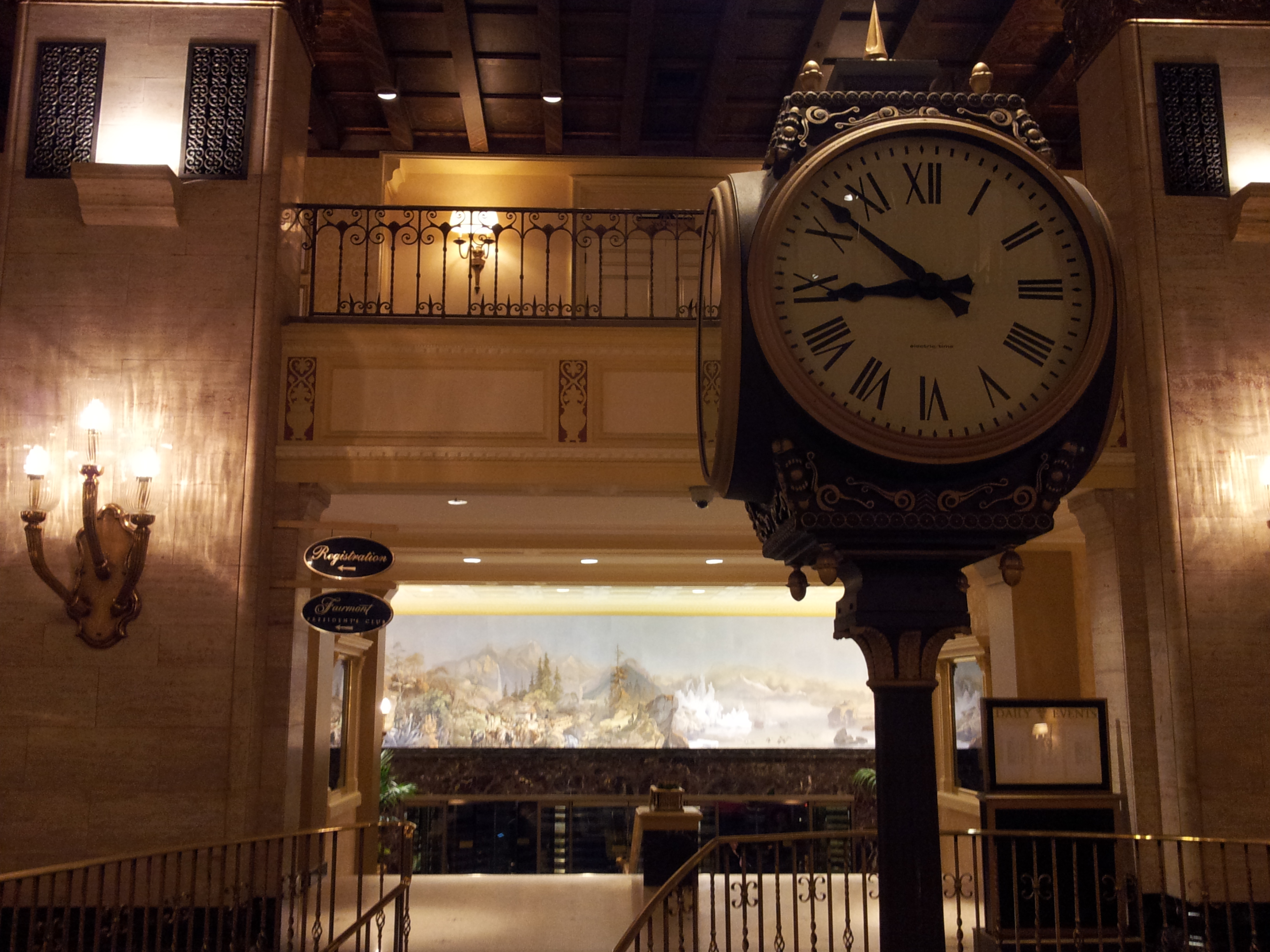
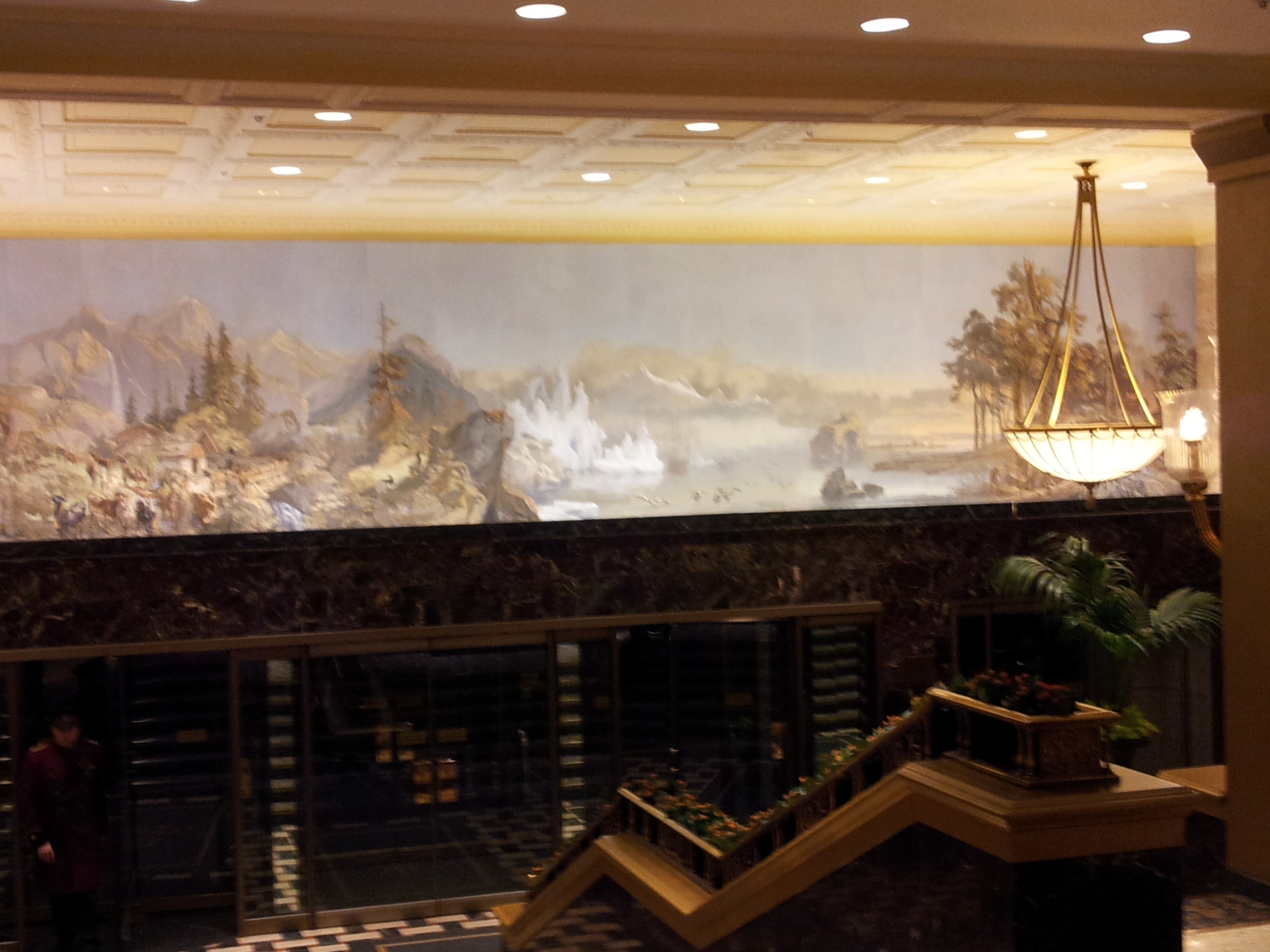
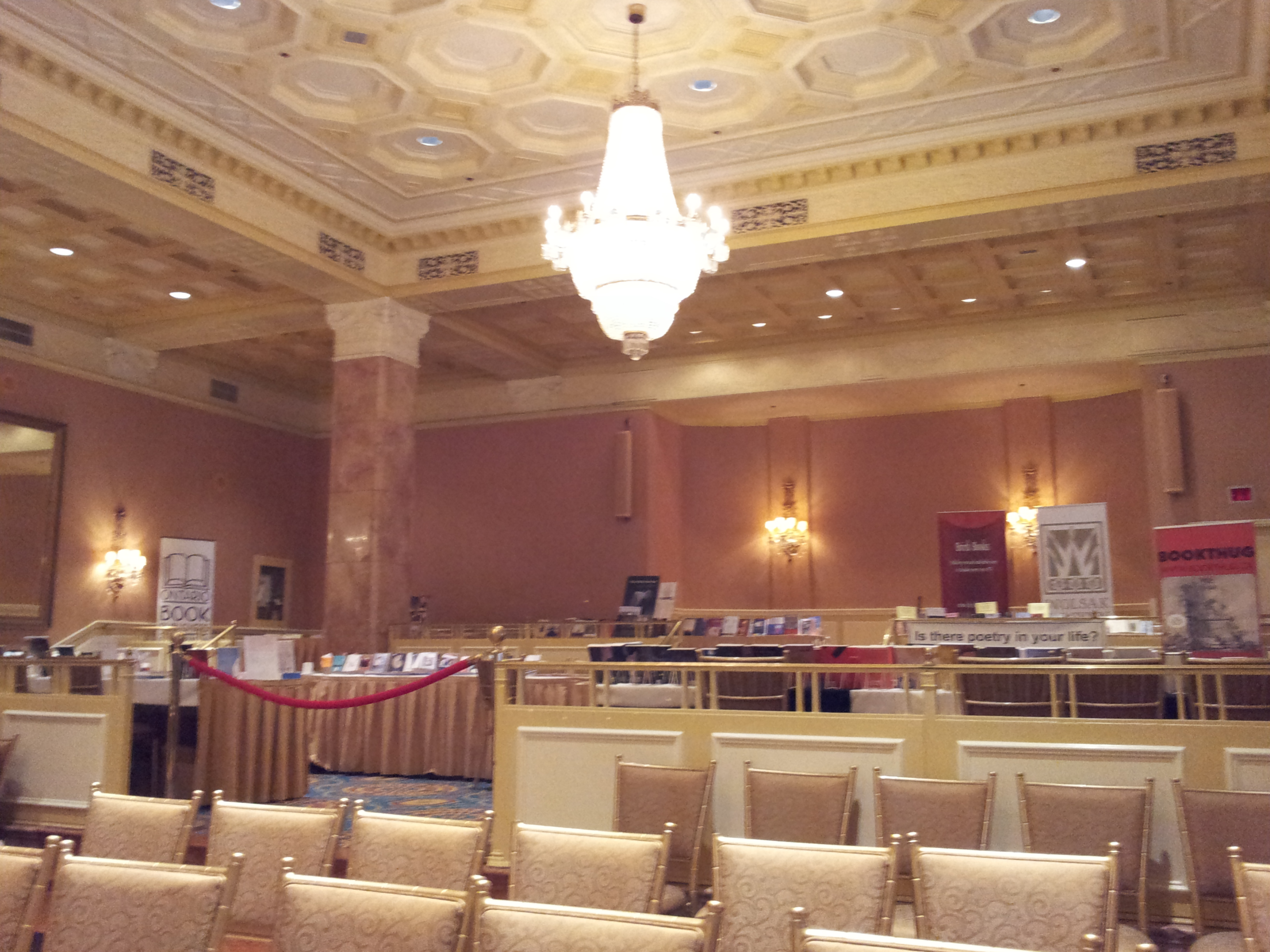
Luxurious is the first word I’d use to describe my experience in Toronto at this year’s NEMLA both spatially as well as intellectually. Taking place at the historic Royal York hotel, I had the opportunity to spend time in a location once visited by Queen Elizabeth and filled with oddly beautiful and yet disconcerting traces of empire.
The first session I attended, on the self-made man in the plays of George Bernard Shaw and Oscar Wilde (5.21), was held in the Quebec Room, which featured a full length mural on one wall of explorers discovering the city in their dug out canoes. An appropriately theatrical setting for a pair of authors who toyed with treasured assumptions of the middle class British male.
Following this session I attended one focused on meeting the needs of our students with flexible teaching methods (6.6). Two of the presenters were interested in the use of fully online or blended courses. Their experience with them sounded mixed. One presenter on the panel focused on the support services available at her school for transitional students who had dropped out of high school prior to attending university or had not imagined themselves as being college material. The final pair of presenters described attempts at their university in Sweden (Uppsala) to shift undergraduate teacher education with a new form of thesis research that emphasized projects that could be used in the classroom to teach students while at the same time encouraging teachers in training to reflect on their teaching practices. My lack of knowledge of the Swedish language prevents me from telling you much about the content of the student theses examples the presenters passed around, but the images suggested that each project was interested in creating an active learning environment for students. Two thumbs up in my book.
The presenters from Sweden had my particular attention in this session as they seem to have found an effective way to close the gap between theory and practice in their discipline. This dilemma has always been one of interest to me, in part motivating the creation of this blog. What good is knowledge when it is hidden in a format that only a small number of people can see and use? These students were learning the most important thing a teacher can learn. Make learning accessible in both literal and metaphorical terms.
From this session on flexible learning I went to a panel presentation on the use of digital tools for learning (7.3). One of my colleagues, Mary Hale, gave an excellent talk on her own suspicions about the digital turn and its limitations for the teaching of literature. The other speakers showed methods of digital pedagogy they had used in the classroom, primarily to contextualize the materials being examined. My favorite approach was the bio-regional one taken by Ken Cooper from SUNY Genesco who with the help of librarian Elizabeth Argentiari created interactive maps and web pages (using OMEKA) that documented the layers of history underlying cultural representations of the Genesee valley. I’ve always been a regionalist at heart and love projects that make students go outside into the landscape (rural or urban) and learn from the people and the land in addition to their textbooks.
One comment on the location for this panel, the Banff Room had clearly been a guest room at some point and was turned into a makeshift presentation space. The old, yellow, peeling, and musty wall paper couldn’t help but remind me of Charlotte Perkins Gilman’s story “The Yellow Wallpaper.” Hands down this was the creepiest conference room I’ve ever been in! But I guess the nineteenth-century feel was appropriate for a nineteenth-century literature and culture panel.
After that stimulating session on the use of digital technology, I took a break to eat, going outside to buy a hot dog from a surly street food vendor. For a moment I thought I was in New York. Then I went back inside the hotel for a panel on postwar Italian representations of World War II (9.2). To my regret, the first presenter, Daniele Pipitone, was unable to attend the conference. I was very much looking forward to learning more about the imagery of the war published by Italian popular magazines in its aftermath. The three presenters I did have the pleasure to hear were very engaging. I especially enjoyed Silvia Ross’s paper on the lack of Italians in the landscape of Ondaatje’s novel The English Patient and Nicole’s lively discussion of counter-factual history in relation to Quentin Tarantino’s film Inglourious Basterds.
The only sour note in the series of panels I attended greeted me on Saturday morning at the round table on adjunct faculty (10.1). I was late attending this panel and only caught the last speaker who delivered a lively presentation of what he felt were the benefits of being a part-time faculty member. Not long before he finished speaking a woman sat down in the back row next to me. We started the discussion portion of the round table and someone asked a question about the gender and racial breakdown of adjunct faculty. I muttered under my breath “the statistics are pretty clear.” And they are. Women and minorities make up the largest number of adjunct faculty.
The woman next to me glowered at me and spoke in a voice between a shout and a whisper: “What statistics? You mean the AAUP ones? Those are skewed. Don’t you know who funded them?” She then proceeded to berate me for believing these statistics and began to cause a distraction for the rest of the people in the room.
Embarrassed, I tried to disengage from her and nearly left the room. I stayed and watched her continue to hijack the discussion, telling everyone in the room to “follow the money” and leave the profession. Eventually the room regained its equilibrium, but the storm blown in by her bitterness put a chill over the rest of the conversation. I left as soon as a I could after that and went to another panel. A sad end for me to what appeared to have been an otherwise positive session.
At every conference I attend, I make a habit of going to a panel on something I know nothing about. This year I decided to attend a round table session on 21st Century Tunisian Women Authors (11.14). The first two presenters spoke solely in French, leaving me to struggle through the remnants of my knowledge of that language learned many years ago as a middle school student in Vermont. Luckily they had slides. I could read and comprehend those easier than their speech, which I struggled to slow down in my head and translate. I must say, however, the struggle was fun and reminded me of why I began to engage in scholarship in the first place, for the mental challenge. The last presenter and much of the discussion was in English. I was particularly interested in what the audience had to say about the role of NGO’s (non-governmental organizations) in the lives of Tunisian women. Trying to help them achieve some measure of autonomy in their lives, many of these NGO’s were acting like 21st century colonizers, trying to impose a model of female autonomy on these women that did not respect their cultural heritage. I left that session wanting to go back and study French if for no other reason than to read the works of these brave women trying to find their voice in a troubled land.
I left this realm of unfamiliar people and language for a more comfortable space in the next session on regionalist writing in the nineteenth-century United States (12.23). All four panelists were excellent. The one that caught my attention most, however, was Florian Freitag’s talk on local color fiction about New Orleans in Scribner’s and other monthly periodicals from the late nineteenth-century. In part my interest was due to his explicit use of the periodical studies method, which is becoming far too rare in contemporary scholarship. Florian is attempting to contextualize the regionalist narratives he is examining within the magazine as a whole, considering both its publishers and their intended audience. I look forward to reading whatever publications develop from his research.
The last panel I attended was a round table on interdisciplinarity and the future of the humanities (13.24). All of us in the room bounced through so many different topics that I can’t possibly cover them all here. Suffice to say that there seemed to be a common thread throughout the discussion that the humanities are worth fighting for and that we as humanities scholars need to do a better job of promoting ourselves and our work. A special shout out is in order to Jean-Paul Boudreau, Dean of Arts at Ryerson University in Toronto, one of our local hosts, for sitting on the panel and reminding us that we should approach our Deans with new ideas and instead of fearing rejection find new ways to argue our case. Proof yet again, that Rhetoric is the mother discipline of all others. ; )
A plane back to Chicago awaited me after that panel, but I would be remiss in not mentioning the two AMAZING keynote addresses. The first was on Thursday where M. NourbeSe Philip and Madeleine Stratford brought their poetry to life for us. Similar life was breathed into the bard on Friday night as Christopher Innes and Brigitte Bogar shared the many adaptations of Shakespeare’s Romeo and Juliet with the audience. Brigitte sang musical adaptations of this classic story of ill-fated love and even shared the stage on two occasions with a ballet dancer who demonstrated two dances used to portray the character of Juliet.
I started this blog post with the word luxurious, using it to describe the setting of NEMLA 2015, but the intellectual aspect of the word has (I find) gotten lost somewhere in my expansive description of the sessions I attended. What made this conference luxurious intellectually for me was that I was able to attend the conference without chairing a panel or presenting a paper. I was simply a tourist in a land of fascinating ideas. This won’t be the case for me next year in Hartford as I left Toronto the newly elected Director of American literature. NEMLA 2016 is likely to be a busy event for me as I try to fill the large shoes of my predecessor, Jennifer Harris, and the amazing conference put together by the NEMLA board this year in Canada. A daunting task, but I’m up for the challenge. See you all in the Charter Oak State!




Military Service and Civic Guilt
Posted by johnacaseyjr in Updates, Veterans on March 20, 2015
How we represent veterans matters. This is a concept central to my research, which attempts to provide historical perspective on the always complicated relationship between armies and the societies they were created to protect. To understand that relationship at a given place and time, I rely on images and phrases that have moved beyond their original more limited symbolic use to become mythic in nature. Once an image or phrase has shifted into the realm of myth, it contains a ready made story within it that viewers or readers don’t need to decode as much as re-enact. Two such phrases that have been on my mind considerably of late are: “more are dying every day” and “thank you for your service.”
The first of these phrases appeared in a somewhat altered form in an article published by the Chicago Tribune on Sunday, March 15 about seven brothers from the Powell family who had served in the Second World War. In that article, the writer addressed a move by the state of Illinois to name a section of highway in Greene County, Illinois “The Powell Brother’s Memorial Highway.” He suggested that state lawmakers should move fast, saying:
“George Powell is the last survivor among the Powell brothers and the lone surviving sibling of the 13 Powell children. He’s also 99 years old, living in a Traverse City, Mich., rehabilitation center. Meanwhile, the number of World War II vets continues to decline. The Department of Veterans Affairs estimates that 550 veterans from that conflict die every day, and that 1.2 million of the 16 million who served in the war are alive today” (“Bad of Brothers.”).
Numbers don’t lie, according to this writer, and consequently we must hurry to honor the service of veterans such as George Powell, “550 veterans from that conflict die every day.” But the question we don’t ask as we read this article is why this war and why this sense of urgency? The writer assumes we already know.
Perhaps we do. But it is worth remembering that the Second World War is one of the “good wars” in American consciousness. Fought to save the world from Fascism and end the human rights abuses of Nazi Germany and the Empire of Japan. In this respect at least, the Second World War bears a strong similarity to the United States Civil War, which was fought to end slavery and nudge the nation in the direction of improving civil rights for black men. So it should come as no surprise that the words and phrases used to describe these conflicts and their legacy are close in nature. Writing in a Galveston, Texas newspaper on Sunday, May 30, 1897, the writer claimed that:
“Nearly two thirds of those who fought in the Civil War have already passed away. Of the 2,800,000 men called into the service of the nation, only a few more than 1,000,000 remain. By 1940 these will be reduced to a battalion of 340, and, five years later, not one will be alive” (“More Than Half Are Dead.”).
There is something uncanny about the writer of this article in the 1890’s referencing dates that would become associated with the nation’s next “good war.” More important, however, is the logic of urgency that we see repeated in this article. The generation associated with the Civil War is rapidly dying off and soon no one with living memory of the war will remain. Honor the veterans while you may for soon none will walk among you.
In the Civil War era, this logic actually proved untrue. Although there is some dispute over when the last Civil War veteran died, many agree that it was some time in the 1960’s or 70’s. This rate of decline would be comparable to that of other wars as the last veterans of World War I have only recently died and the last veterans of the United States Revolutionary War died in the 1820’s and 30’s.
Belief in the rapid mortality of World War II vets, the last examples of what to the national mind must appear to be a blissfully uncomplicated war, is paired with the concept made visible in the phrase “thank you for your service.” Naming a roadway for George Powell and his brothers is one method of thanks. But now we find many businesses offering discounts to veterans and their families and the presence of a man or woman in uniform elicits spontaneous applause in airports and train stations. One veteran, Dave Duffy, complains in a Washington Post editorial from Thursday, March 19 that this action by U.S. civilians puts soldiers on a pedestal. He says:
I get it that society is grateful for our military service, and reasonably so. I also believe that society’s overboard efforts to recognize military service are directly related to the lasting guilt over how we treated returning Vietnam veterans….Teachers, police officers, firefighters, doctors, nurses, scientists, social workers, civil servants, diplomats and, yes, military all do our part to make our society a bit better while taking care of our citizens. All deserve admiration and thanks. (“Stop Putting Our Soldiers On a Pedestal.”).
Retired Lieutenant Colonel Duffy makes an important point that service should be the reason we honor veterans rather than latent guilt. Service to the country is what makes the concept of republican government work in the first place. Without people willing to vote, serve on juries, run for political office, and the many other thankless but necessary tasks that make up life in a participatory society, we do not have a participatory society.
So where does this leave us? How should we represent veterans and interact with them in a meaningful way?
I’ve thought about this question a great deal even as I’ve spent much of my time contextualizing the ways in which symbolic language use got us to the point we are at today. The best answers that I’ve arrived at so far are: Ask veterans how they would like to be remembered. Remember that not all veterans are the same.
Knowledge is the best cure for stereotyping of any person or group. For what is a myth but a form of stereotype? If you don’t know a veteran, make a point of befriending one in a genuine way. If you know a veteran, take the time to speak with them about their service. Also, it is important for all U.S. citizens to learn more about the military system that your tax dollars support. The civilian military gap can’t solely be blamed on soldiers. There is a lot as civilians that we simply don’t want to know. Army life is one of those things.
Searching for the Right Metaphor: Veterans in Popular Culture
Posted by johnacaseyjr in Civil War, Updates, Veterans on August 21, 2014
My research on veterans has been driven by a number of questions. Foremost among them has been how we as a culture choose to represent veterans in the United States. Naturally the answer to this question depends upon the war discussed. Conflicts far distant in our imagination take on a mythic status. Minute Men and the civilian militia dominate our mental portrait of The Revolutionary War while Johnny Reb and Billy Yank still loom large over the United States Civil War. World War Two remains framed by the “Greatest Generation” label associated with it by former news anchor Tom Brokaw. The Vietnam war is only slowly beginning to mythologize as its veterans advance in age and the war fades from living memory.
Part of the reason I chose to write a book on veterans of the Civil War was the challenge associated with attempting to recover the actual lives of veterans who fought in one of our nation’s most mythologized conflicts. Moving beyond the statues of Johnny Reb and Billy Yank that stand in town squares throughout most of the United States, I wanted to know: What had soldiers of the Civil War survived? How did they understand it? How did non-combatants understand them? What I discovered was that the Civil War served as a turning point in the way veterans were understood in American culture. It set in motion ways of understanding former soldiers that remain influential today.
We tend to take for granted that veterans are different from civilians. This assumption was not widely shared until the late nineteenth-century. Military service was a skill or craft and participation in a war one of the many events that took place in a man’s life. The unique nature of the Civil War, which nearly destroyed the country, marked the soldiers who survived this conflict differently from their forebears. In the last years of the war, the pace of combat also changed leaving soldiers psychologically scarred by events they did not have time to process until much later in their lives.
Civilians viewed the growth of the veteran as a distinct social category with apprehension. On the one hand, they were viewed as wounded warriors in need of civilian care and sympathy. On the other, veterans were a potentially destabilizing force to society. For every image of a pathos laden amputee returning to his family in Civil War era newspapers and magazines there was also a tramp, addicted to alcohol and drugs and never quite able to get his life together after the war. In spite of the gender assumptions of the era, it did not seem clear at all that war made men. Instead it seemed to unman them or remake them into something vaguely monstrous.
Time passes and the details change, but the Janus-like figure of the veteran as victim or threat remains. They are two different ways of looking at soldiers and yet they are inextricable from each other. Perhaps the best example in our own times remains the film First Blood (1982). John J. Rambo is a special forces veteran of the Vietnam War. Most viewers of the film will readily remember the action sequences as Rambo unleashes his military training upon a small town in the pacific northwest. What often gets forgotten, however, is the somber way in which the film begins. Rambo is a tramp. We first see him hitchhiking with his battered field jacket and pack. He is looking for fellow survivors from his unit in the war. His travels bring him to the pacific northwest where he discovers that another comrade has died since the war, this one of cancer. Not long after this depressing discovery, Rambo is confronted with a Sheriff who attempts to get him to leave his town. He rebuffs the Sheriff’s attempts to push him back on the road and gets arrested. Rambo is mistreated in prison and memories of the war emerge. Suddenly he sees himself as a P.O.W. in North Vietnamese captivity. Rambo escapes and engages in an epic battle with local law enforcement and the national guard. It is only when his former commander comes to “take him home” that the violence ends and peace is restored to the small town.
One doesn’t often expect to find a parable contained in a popular film, but First Blood is the veteran parable as we’ve inherited it in perfect form. Initially an object of pity, it takes very little effort for Rambo to become a threat. He has brought the war home with him and disrupted the lives of those far removed from it. Only by removing him can peace be restored. A soldier once, he is a soldier forever.
A better film in many respects than First Blood, winning six Oscars, The Hurt Locker (2008) nonetheless helps to perpetuate the “soldier once, soldier forever” theme. Bomb technician Sergeant William James is the protagonist of this film. Far from being a tramp, he is instead presented as a reckless adrenaline junky. James pushes the limits with each mission and in the process risks getting himself and his team blown up by a bomb. When he returns from his combat rotation, James attempts to readjust to civilian life with his family. We see him cleaning the leaves from the gutters of his home, helping his wife chop vegetables for dinner, watching the baby, and helping his wife shop at grocery store. In most of these tasks we see James attempting to feign some interest. We even see him filled with greater terror at the overabundance of the U.S. supermarket than he ever exhibited on the war-torn streets of Iraq. Uncomfortable at home, James re-enlists and the last we see of him he is leaving a troop transport at the airport for his new base.
Surprisingly, few have noted the significance of the name William James being used for the protagonist of this film. Nineteenth-century U.S. psychologist and philosopher William James was a proponent of a “moral equivalent of war.” Like most of his contemporaries, James wanted to believe in the man-making power of military service. At the same time, however, he had seen how the Civil War had scarred his younger brothers Wilky and Bob. James wondered if the uplifting aspects of the soldier’s life could be separated from the ugliness of war. The Hurt Locker has no such interest in war’s moral equivalent. Nevertheless, it does, like James’s research, remind us that war is not the soldier’s problem. It is a shared concern for the society that creates armies and sanctions war. In the end, this is what our current metaphors seek to evade. War is many things, but at its heart it is a social pathology rather than an individual malady.
No image can do justice to the full range of experience in any person’s life. Veterans are people with all their faults and virtues. They are also complex texts for a society to read and interpret. Unlike dead soldiers they talk back. Their stories bend and twist down many roads, assaulting our assumptions about ourselves and our world. That’s one reason why we continue to search for the right metaphor.
Humanities 2.1: A Follow Up to A Millennial’s Response to the Digital Humanities
Posted by johnacaseyjr in Updates on October 14, 2013

Michael Lobocki
October 11th, 2013
ENG 240 – 36394
Humanities 2.1
In week six’s response paper, I was a cheerleader for the possibilities and potential that the Digital Humanities offers to both the classroom and personal scholarly pursuits. In week seven, that stance has not changed. I still believe that the boom of technological advancements born from the ashes of the “dot com bust” carries the possibility of a true explosion of literary competence and community. However, through this week’s reading, I was presented with various complaints of DH and how/why they are yet to be utilized to their fullest potential.
I’ll begin by saying that as a daily suburban commuter via the Metra train system, I have the opportunity to rub elbows with every walk of life for upwards of three hours per day. Recently, I took note of the fact that roughly approximated, 70…
View original post 1,112 more words
A Millennial’s Response to the Digital Humanities
Posted by johnacaseyjr in Updates on October 12, 2013
Michael Lobocki
October 4th, 2013
ENG 240 — 36394
A Millennial’s Response to the Digital Humanities
As a millennial, I feel as if I have a naturally engrained desire to see Digital Humanities succeed. Throughout my entire educational career, the importance of computer literacy has been stressed via numerous typing and computer-aided research courses. Despite sitting through painfully tedious lectures on the “home row” typing technique, I feel as if for the first time, the threat of “pay attention because you’ll be using this for the rest of your life” has—and will continue to—come true. While I haven’t written in cursive in almost ten years and I can’t remember the last time I did manual long division, I use computers and the internet as a vessel for academic research almost every day of my life.
“Digitial Humanities” is defined as “a field of research, teaching, and invention…
View original post 749 more words
 John A Casey Jr